Costs
What AI automation actually costs a small business
Most AI agencies won't put a number on a page, which is why business owners assume the answer is 'enterprise money'. It isn't, for well-scoped work. Here are the ranges we see across the Australian market, what drives them, and the running costs that turn up on the credit card after launch.
Rather just ask someone? Talk to usIn short
In Australia in 2026, a single well-scoped workflow automation with an AI step typically costs a few thousand dollars to build. A custom AI agent with several integrations runs from the mid thousands into the tens of thousands. Running costs are usually tens to a few hundred dollars a month. A good first project pays back in hours saved inside a few months.
Indicative Australian ranges
Drawn from pricing published by Australian AI agencies and our own scoping in 2026. Ranges, not quotes, and ex GST.
- One workflow automation $2,500 – $7,000
- A trigger, a few steps, one or two integrations and an AI step to read or draft. The usual first project.
- Custom AI agent $5,000 – $20,000
- A scoped job with tools, decision logic, approvals and logging. The top of the range is several integrations and real edge-case handling.
- AI receptionist or enquiry handling $3,000 – $10,000
- Chat, email or phone triage with booking and hand-off. Voice adds to the build and to monthly minutes.
- Monthly running costs $30 – $500
- Model usage, an automation platform, hosting. Scales with volume. Most small businesses sit at the low end.
- Ongoing support Optional
- Monitoring and tweaks as your business changes. Some agencies bundle it into a retainer; we quote it separately so you can say no.
What actually matters
Integrations set the price, not the AI
The model call is the cheap part. What costs money is connecting to Xero, your CRM, your booking system and your inbox reliably, and handling what happens when one of them changes. Count the systems the workflow touches and you've roughly counted the cost.
Judgement costs more than steps
Every place the software has to decide something is design, testing and guardrails. A workflow with no decisions is cheap. One with three is an agent, and priced like one. Push decisions to a person wherever the volume allows and the price drops.
Running costs are real but small
Expect a model bill, a platform bill and maybe hosting. For a small business that's usually tens of dollars a month, occasionally a few hundred at volume. What it isn't is per-seat licensing that grows with your team. Ask for the running-cost estimate in writing before you sign.
Retainers are optional, and you should be told that
Some agencies price low up front and recover it on a monthly retainer. That's a legitimate model, but you should know which one you're in. We quote the build fixed, quote support separately, and hand over everything so you can walk away.
The payback test is arithmetic
Hours saved per week, times a realistic hourly cost, times fifty. If that number doesn't cover the build inside twelve months, don't do it, whatever the vendor says about transformation. Most good first projects clear it in three to six.
Count the cost of checking
For the first month someone has to check the output. That's an hour or two a week, and it's part of the cost. It drops sharply once the edge cases are handled, but a proposal that doesn't mention it hasn't been built in a real business.
Questions to ask before you sign
Straight answers to all seven should be easy. If they aren't, that's your answer.
- What exactly triggers it, and what does it do when the trigger is malformed?
- Which systems does it connect to, and what happens when one of them changes?
- What does it do without asking, and what needs a person's approval?
- What's the estimated monthly running cost at my volume?
- Who owns the workflow, the accounts and the code when we're done?
- What does support cost, and can I say no to it?
- How will we measure the hours saved?
When this isn't the answer
The cheapest AI automation is the one you don't build. If the task is under an hour a week, a template and a checklist wins. If the trigger isn't digital yet, fix that first, and it might not be an AI project at all. Our first call is free precisely so we can say this before anyone spends anything.
Start with a 30-minute call
Tell us the task that eats the most time, or just that you're not sure where to begin. We'll tell you on the call whether it's worth automating, and what we'd do first.
Common questions
Partly because scope varies, partly because it's easier to sell on a call. Scope does vary, but ranges are still possible and useful, which is why we publish them here and quote a fixed price before starting.
No. Well-built automations run for months without attention. A retainer makes sense if your business changes often or you want someone watching. It should be a choice, not a condition.
Model usage at higher volume, the time your team spends checking output early on, and changes to the systems the automation depends on. None are large, and all of them should be named in the proposal.
A part-time admin role in Australia costs tens of thousands a year. A first automation that saves five hours a week is a fraction of that, but it only replaces the repeatable part of the work. It's a productivity gain more often than a headcount saving, and we'd rather you plan for that.
Not for automation builds. We scope after a short call and quote a fixed price for the build. Support is quoted separately so you can take it or leave it.
See it working
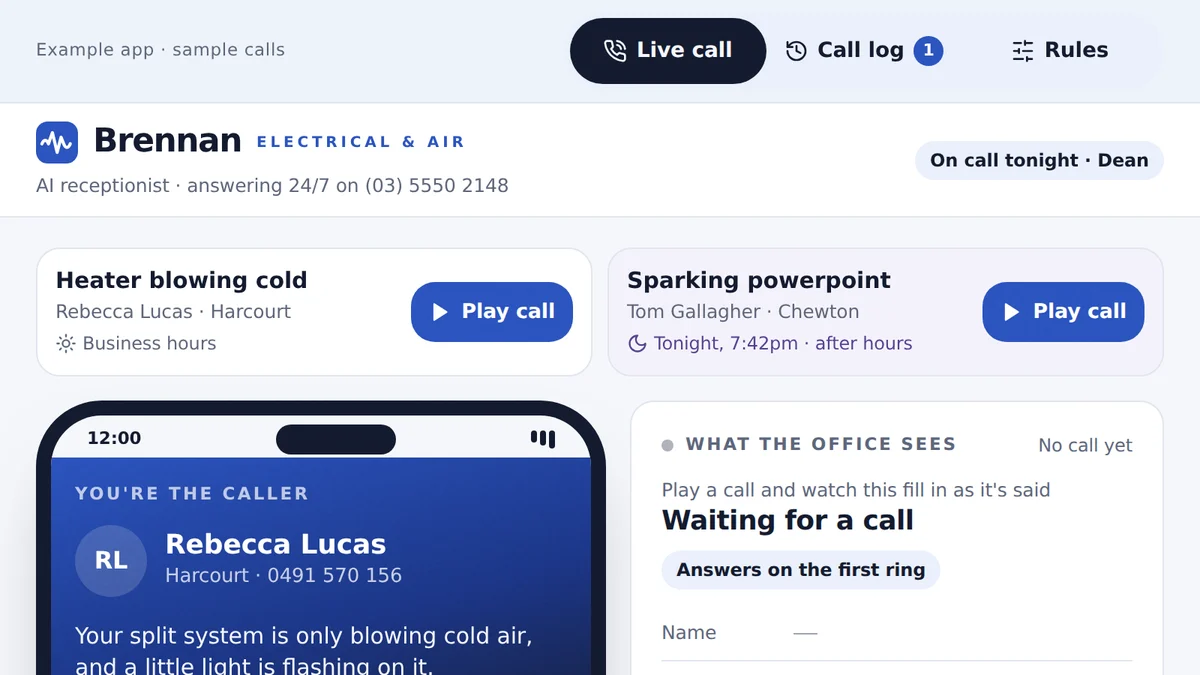
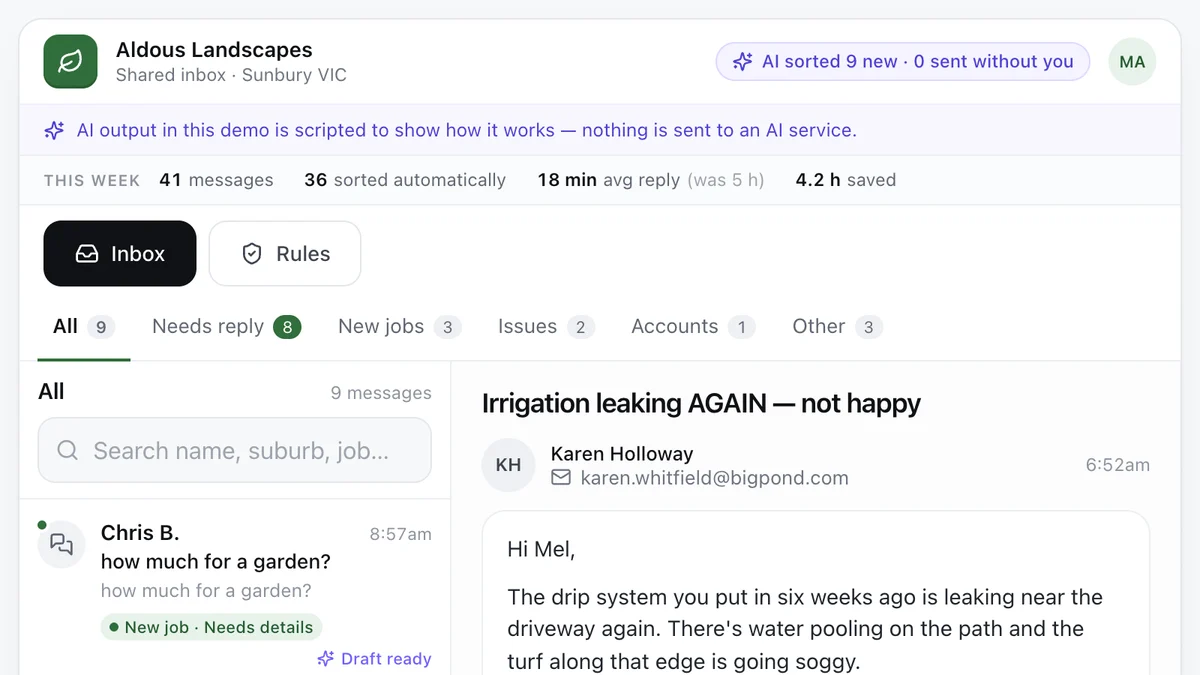
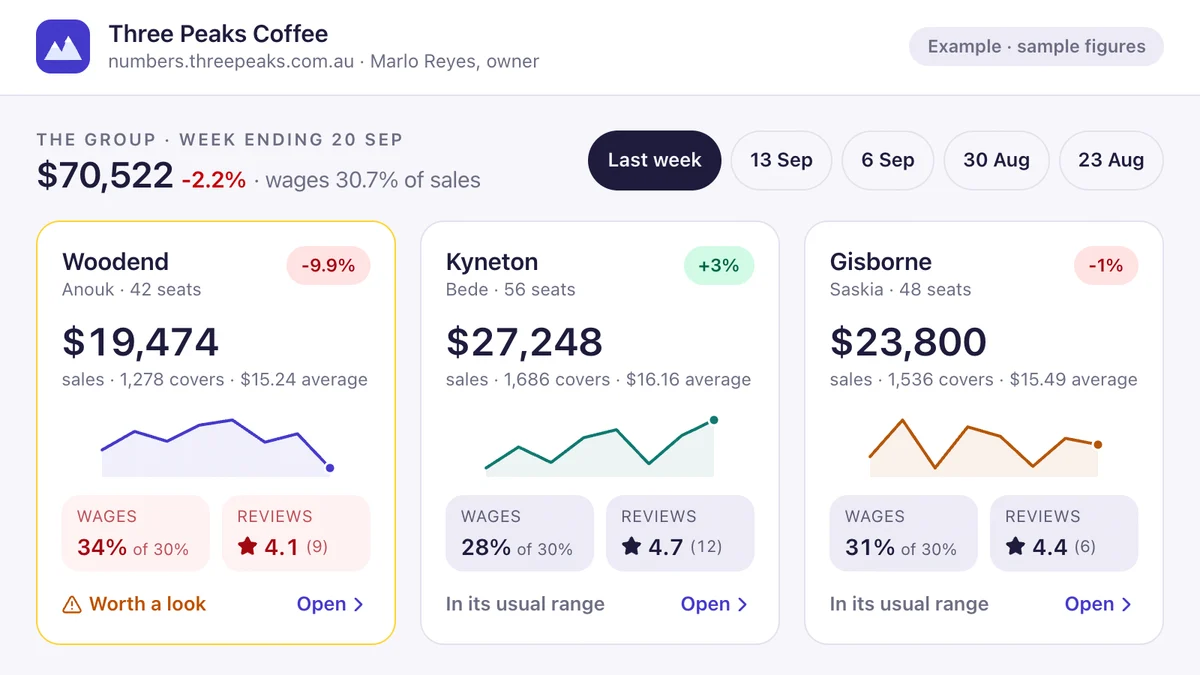
Software we'd build, running with a fictional business and sample data. Use it, then decide.
Also worth a look
- Where to Start With AI in a Small Business
- AI Agent vs Automation vs Chatbot
- Is AI Safe for My Business? Privacy and Control
- Want the do-it-yourself guide to showing up in AI answers?
Last reviewed . Figures are indicative Australian ranges, not quotes.