Plain English
Chatbot, automation or AI agent: which one do you actually need?
Every vendor now sells 'AI agents', and much of what ships is a chatbot with a new name or an automation with an AI step bolted on. The three are genuinely different tools. They cost different amounts, they break in different ways, and choosing the wrong one is the most common way we see small businesses waste money on AI.
Rather just ask someone? Talk to usIn short
A chatbot talks. An automation follows fixed steps when something happens. An agent is given a goal, tools and permission to decide the steps itself. Most small businesses need automation with an AI step for reading or drafting. Agents earn their keep only when the work needs judgement every time, and they need guardrails to match.
- What is an AI agent, without the marketing?
- Software that's handed a goal ('deal with this enquiry'), a set of tools it may use (read the inbox, check the calendar, draft a reply, create a record), and the freedom to work out which steps to take. That freedom is the point and the risk. A fixed automation does the same thing every time and fails loudly when the input is unexpected. An agent adapts to the unexpected, which means it can also adapt in a direction you didn't want. Good agent design is mostly deciding what it may never do.
What actually matters
Start from the shape of the work
If the task has the same steps every time, it's an automation. If it's a conversation with a customer, it's a chatbot, and probably not needed. If it's 'look at this, work out what it is, and do the right thing', it's an agent. Most 'we need an agent' requests are automations with one messy step, and the messy step is where a small AI call does the reading.
Automations are cheaper because they can't surprise you
A workflow that moves a form submission into your CRM and drafts a reply costs a fraction of an agent and behaves identically at 3am on a public holiday. Predictability is a feature. Reach for it first, and only give the software discretion where the task genuinely can't be reduced to steps.
Chatbots are customer-facing, so their mistakes are public
A bot on your website that gets a price wrong has told a customer something false in your name. That's why we talk most clients out of them. The exceptions are real: a large catalogue, a help centre people actually search, or a volume of repeat questions a human can't keep up with.
Agents need a fence, not just a brief
The design work on an agent is the list of things it may not do: never send to a customer without approval, never change a price, never touch a record outside its scope, always log what it did and why. An agent without that list isn't autonomous, it's unsupervised. Ask any vendor for theirs.
Judge by the exceptions, not the demo
Every demo shows the happy path. Ask what happens when the email is in the wrong language, the attachment is a photo of an invoice, or the customer changes their mind halfway. Automations should stop and flag. Agents should escalate. If the answer is 'it just handles it', keep asking.
Expect to combine them
A realistic build for a small business is one automation that catches the trigger, an AI step that reads the messy part, a small agent that decides between three outcomes, and a person who approves anything that leaves the building. Naming it one thing is marketing. Building it as four small things is engineering.
Side by side
The differences that decide cost and risk.
| Criteria | Chatbot | Automation | AI agent |
|---|---|---|---|
| What it does | Answers questions in a conversation | Runs fixed steps when something happens | Works out the steps to reach a goal |
| Handles messy input | Somewhat | Poorly, unless an AI step reads it | Yes, that's the point |
| Makes decisions | No | Only branches you defined | Yes, within limits you set |
| Who sees its mistakes | Your customers | Usually your team | Depends entirely on the guardrails |
| Typical first-project cost | Low to mid | Lowest | Highest |
| Runs unattended | Yes | Yes | Only inside the fence |
| Right for | High-volume repeat questions | Anything with a pattern | Work that needs judgement every time |
When this isn't the answer
If you're reading this to decide whether to buy an agent, the answer is probably an automation. We build agents, and we still start almost every client on the simpler thing, because it proves the value in weeks and costs less to run. Come back for the agent once the automation has shown you where the judgement calls actually are.
Start with a 30-minute call
Tell us the task that eats the most time, or just that you're not sure where to begin. We'll tell you on the call whether it's worth automating, and what we'd do first.
Common questions
Ordinary ChatGPT chat isn't. It's a model you talk to. ChatGPT's agent mode is, because there the model is given a goal, tools and permission to act. The same model can sit inside a chatbot, an automation step or an agent; the wrapping decides which one you've got, and a business agent still needs its own fence.
Yes, and this is the most useful combination for small businesses: a fixed workflow with one step that asks a model to read an email, extract the details or draft a reply. You get the predictability of automation with the reading ability of AI.
When the input varies too much to branch on, the right action depends on context, and the volume is high enough that a person triaging it is a real cost. Inbox triage, document processing across many formats, and multi-step research are the usual cases.
Most small business sites don't. A visible phone number and a form that works convert better. If you have hundreds of the same question a month, or a catalogue people struggle to search, a well-built one can pay off. We wrote a whole guide talking people out of it.
For automations, n8n and Make where they fit, custom code where they don't. For AI steps and agents, Claude and other current models, chosen per task. You own whatever we build and it runs on accounts you control.
See it working
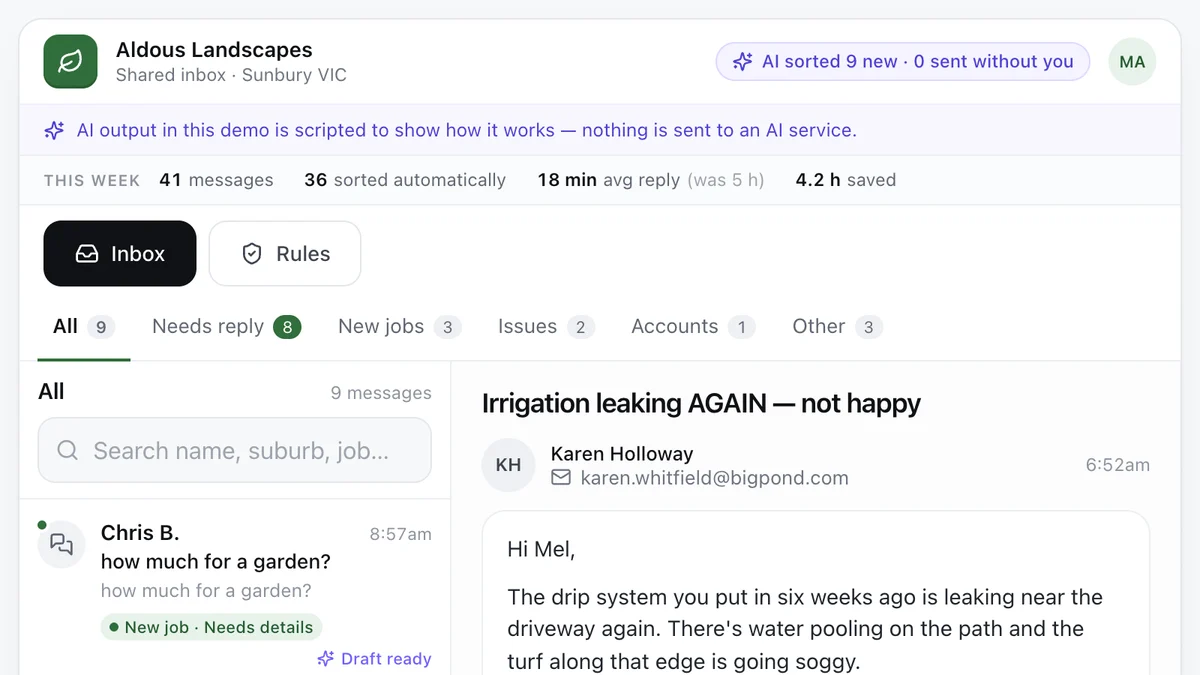
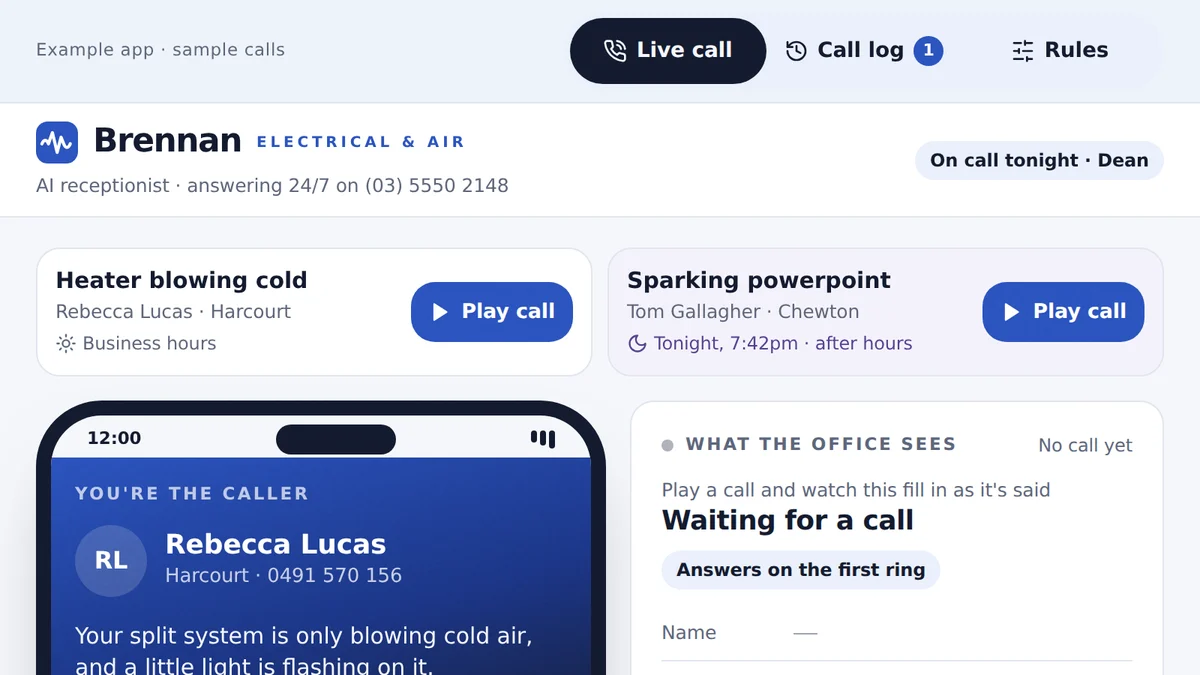
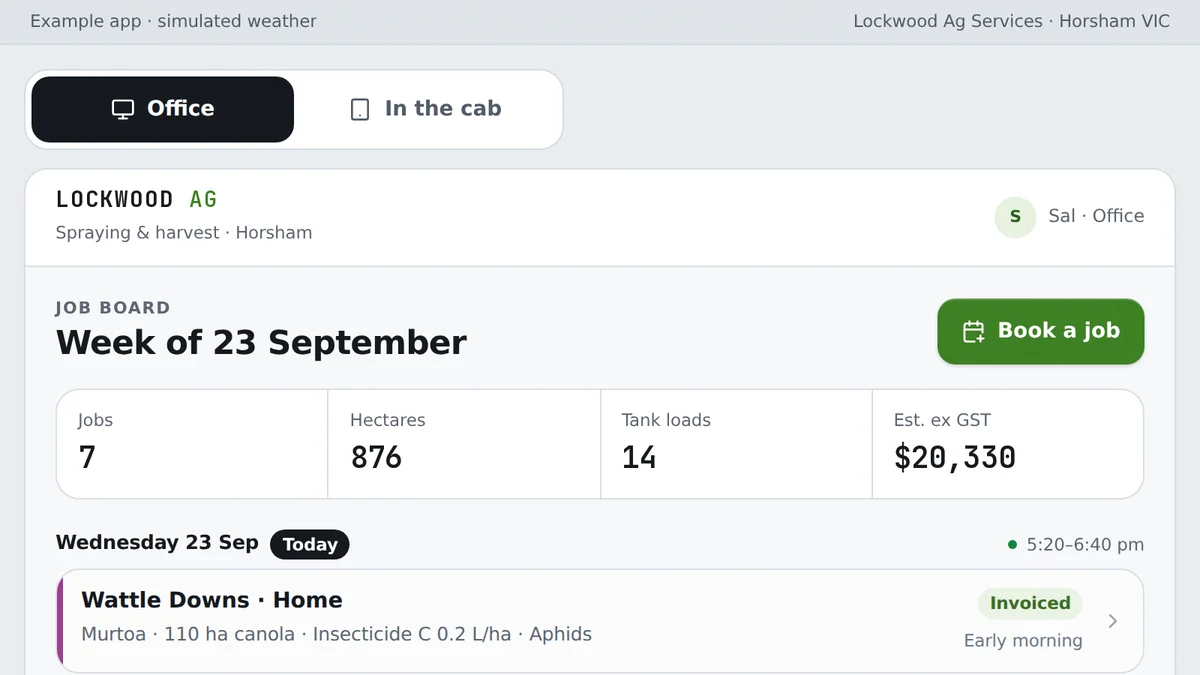
Software we'd build, running with a fictional business and sample data. Use it, then decide.
Also worth a look
- Where to Start With AI in a Small Business
- What AI Automation Costs in Australia (2026)
- AI Receptionist for Australian Small Businesses
- Want the do-it-yourself guide to showing up in AI answers?
Last reviewed . Figures are indicative Australian ranges, not quotes.