Enquiries and bookings
An AI receptionist that answers, books, and knows when to hand over
A missed call from a new customer is usually a lost customer; they ring the next number on the list. An AI receptionist answers every time, on the phone, on your website or in your inbox, takes the details, books the job where it can, and passes the rest to a person with everything written down. Done well it's the most obvious win in small business AI. Done badly it's the thing customers complain about.
Rather just ask someone? Talk to usIn short
An AI receptionist answers calls, chats and emails when you can't, captures who's asking and what they need, books appointments into your calendar where your rules allow, and hands anything else to a person with a written summary. It should never quote prices you haven't set, promise timeframes, or pretend to be human when asked.
- What an AI receptionist is, and isn't
- A system that sits on your phone line, website chat or inbox and handles the first contact: greeting, understanding what's needed, collecting details, answering the questions you've given it answers to, and booking or escalating. It's not a chatbot that improvises, and it's not a replacement for the person who does the work. Think of it as a very reliable front desk with a strict script for anything involving money or promises.
What actually matters
Decide what it may book without you
Simple, bounded jobs with fixed durations can be booked straight into the calendar. Anything that needs a site visit, a quote or a judgement gets captured and handed over. That rule set is the whole product. Write it down before the build starts.
Give it answers, not permission to invent them
Opening hours, service areas, what you do and don't do, how to prepare for an appointment: things with one correct answer. Prices only if you've fixed them. For everything else, an honest 'I'll have someone call you back' beats a confident guess every time.
Make hand-off fast and complete
The measure of a good receptionist is what the person receives: name, number, what they need, when, and the transcript. If your team has to ring back and ask everything again, the system has saved nobody anything.
Phone, chat and email are different jobs
Chat and email are cheap and forgiving; a two-second pause is fine. Phone needs a natural voice, real-time speech, and graceful handling of interruptions, and it costs more to build and run. Many businesses start with chat and email, and add voice once the rules are proven.
Say it's AI when someone asks
Customers don't mind talking to a system that's helpful. They mind being deceived. Say so if asked, offer a human path, and keep the tone plain. From 10 December 2026, businesses covered by the Privacy Act must also say in their privacy policy when personal information feeds automated decisions that could significantly affect someone, so being open about it now costs nothing.
Read the transcripts for the first month
Weekly. You'll find questions you didn't anticipate, a service area you forgot, a booking rule that needs a tweak. That review turns an adequate receptionist into a good one, and it's the part most vendors skip.
Your options for the front desk
What each one costs you in money, missed calls and errors.
| Criteria | Person on staff | Answering service | AI receptionist |
|---|---|---|---|
| Answers after hours | Rarely | Yes, scripted | Yes |
| Books into your calendar | Yes | Sometimes | Yes, within rules you set |
| Knows your business | Deeply | From a script | From what you give it, exactly |
| Handles judgement calls | Yes | No | No, it hands over |
| Cost | Salary | Per call or monthly | Build, then small monthly usage |
| Consistency | Varies | High | Very high |
When this isn't the answer
If you get a handful of calls a day and someone is already there to answer them, an AI receptionist solves a problem you don't have. It earns its place when calls are missed, when enquiries arrive overnight or over the Christmas shutdown, or when the person answering is also the person doing the work. And if your customers are mostly older or the work is sensitive, a human voice may simply be the better product.
Start with a 30-minute call
Tell us the task that eats the most time, or just that you're not sure where to begin. We'll tell you on the call whether it's worth automating, and what we'd do first.
Common questions
Yes. Voice systems can sit on your existing number, answer in a natural Australian voice, take details and book. They cost more than chat or email handling, both to build and per minute, so most businesses prove the rules on chat first.
Often they'll guess, and it should confirm if asked. The goal isn't to pass as human; it's to be useful and to hand over cleanly. Customers judge the outcome, not the voice.
It captures the details and passes them to a person, with a summary and the transcript, by text, email or into your CRM. Nothing is dropped; the difference is that your team starts with the facts already written down.
Usually. Cliniko, Halaxy, ServiceM8, Calendly, Google Calendar and most systems with an API can be connected. Where there's no API we'd tell you, and you'd probably want a better booking system first.
For chat and email handling with booking and hand-off, a few thousand dollars to build and a small monthly usage cost. Voice adds to both. Our costs page has the ranges.
See it working
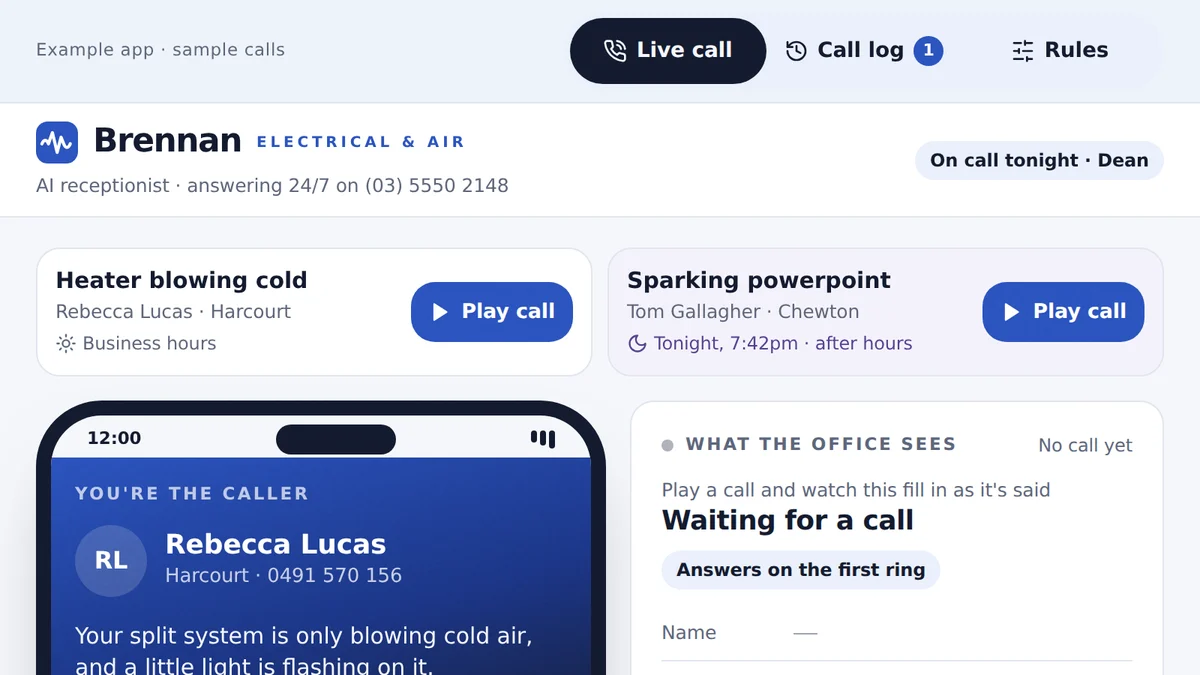
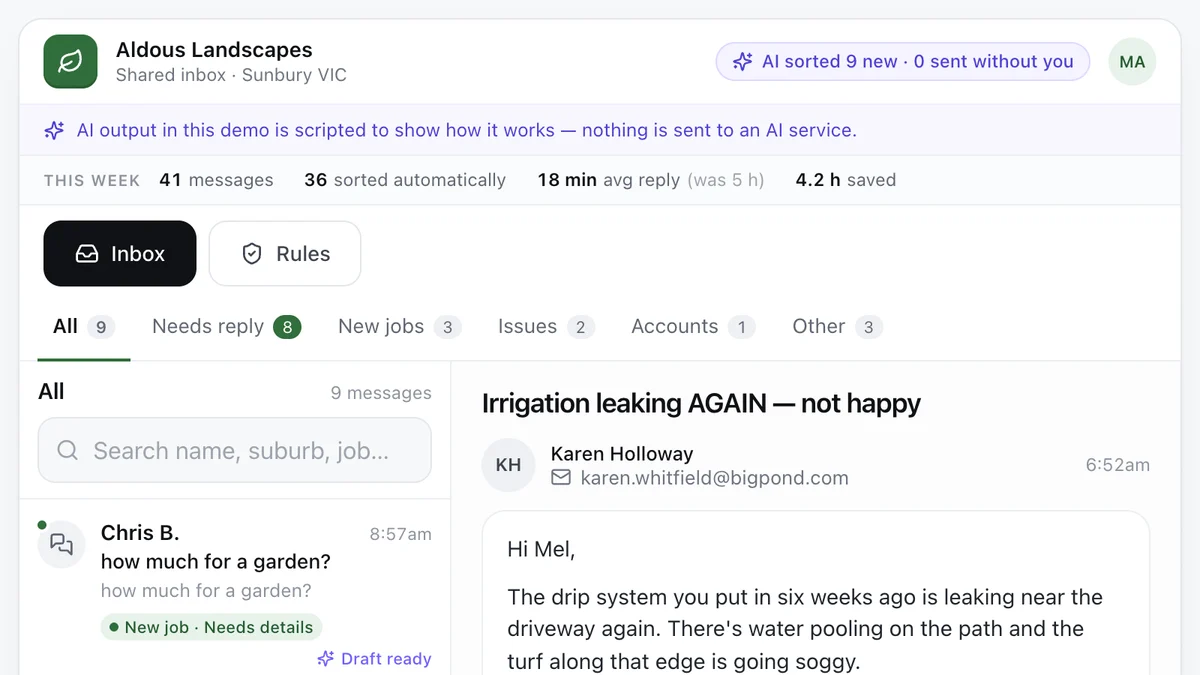
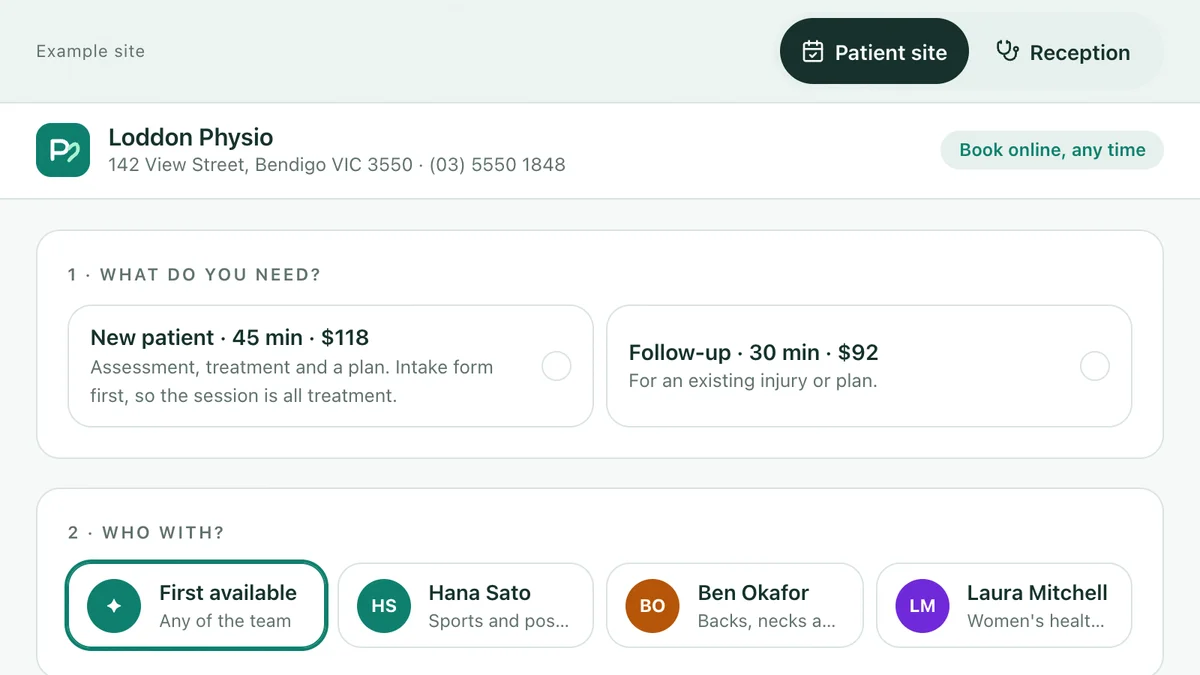
Software we'd build, running with a fictional business and sample data. Use it, then decide.
Also worth a look
- AI Agent vs Automation vs Chatbot
- What AI Automation Costs in Australia (2026)
- Where to Start With AI in a Small Business
- Want the do-it-yourself guide to showing up in AI answers?
Last reviewed . Figures are indicative Australian ranges, not quotes.