On-demand development team
A senior development team you switch on when you need it
Hiring in-house takes a quarter, costs a recruiter's fee before anyone writes a line, and leaves you carrying salaries when the work slows. An agency hands you a project manager and a rotating cast. This is the third option: a small, senior team that already works together, engaged for an agreed number of days a month or a fixed-price build, and switched off when the job is done.
Work moves across the board in fortnightly increments, and every increment ships to an environment you own.
In short
PixelApps provides an on-demand development team to Australian businesses: senior developers and a product designer, led by one person accountable for delivery, engaged for a fixed monthly block of days or a fixed-price project. There are no juniors, no bench you pay for, and everything is built in repositories and accounts you own.
This is for you if
- A business with a product and no in-house engineering, which needs it built and kept moving
- An in-house team that needs senior capacity for a defined push: a launch, a migration, an integration
- A company that has outgrown a single freelancer and isn't ready to hire a department
- A founder who needs a team and someone to direct it, in one engagement
- A rescued or inherited app that needs finishing by people who have finished things before
It isn't if
- A company that needs twenty engineers by next month. We are a small senior team with a specialist network, not a body shop.
- A buyer whose only criterion is the lowest hourly rate. Offshore is cheaper by the hour, and our guide on it says when that's the right call.
- Seats to fill under your own process with no say in how the work is done. That's staff augmentation, and a recruiter will serve you better.
What you get
Senior people only
Every developer and designer on the team has shipped production software that businesses depend on. No juniors learning on your budget, and no substitutions after the sales call.
One accountable lead
A single person who owns delivery, attends your planning, and can be asked how it's going and get a straight answer. Not a project manager relaying messages.
Working software every fortnight
Each increment is deployed to an environment you can open and use. Progress is something you click, not a percentage on a slide.
Your repositories, your accounts, your data
Code, hosting, domains, databases and third-party services are registered to your business from day one, with us as collaborators. Ending the engagement is a matter of removing access.
Design in the team, not bolted on
A product designer works alongside the developers, so screens are designed before they're built and the thing that ships is the thing that was meant.
A written scope and a fixed number
What's in, what's out, what you supply, and what it costs, agreed before work starts. Changes are priced when they're raised, not discovered on the invoice.
Three ways to engage
The cadence is agreed up front and can change with a month's notice. The fee is fixed in writing on the first call.
Fixed-price project
A defined scope, a date, a number
For a build with clear edges: a platform, a portal, an integration, an MVP. Scoped in writing, priced up front, delivered in fortnightly increments you can use.
Standing team
An agreed block of days each month
For a product that's live and needs to keep moving. A stable team, a fortnightly cadence, a monthly fee fixed in advance, month to month.
Care and small changes
from $750 per month
For a product that mostly needs looking after: hosting, updates, security patching, backups, monitoring and a small block of development each month.
The first ninety days
- 01
Week one: the first call
What you're building, what exists, who's involved and what's driving the timing. We say on the call whether we're the right shape, and roughly what it will cost.
- 02
Weeks one to two: scope in writing
A short written scope with what's in and out, the environments and accounts to set up in your name, and either a fixed price or a monthly block of days.
- 03
From week two: fortnightly delivery
Planning at the start of each fortnight, a deployed increment at the end of it, and a written note on what changed. You see the product move every two weeks.
- 04
Month three: the review
What's shipped, what it cost, what's next. Continue, scale up, scale down to care and small changes, or hand over to an in-house hire we help you make.
On-demand team, in-house hire, offshore or freelancer
Each is the right answer for somebody. The differences that matter are speed to start, who carries the risk, and what happens when someone leaves.
| Criteria | On-demand team | In-house hire | Offshore team | Freelancer |
|---|---|---|---|---|
| Time to productive | Two weeks | Three to five months, including ramp | Weeks, plus the management overhead | Days, if you find a good one |
| Who manages the work | Our lead, with you | You, or a manager you also hire | You, across a time zone | You |
| When someone leaves | The team absorbs it. Nothing lives in one head | You start the hiring process again | A replacement you didn't choose | The project stops |
| Design | In the team | Another hire | Usually extra, usually thin | Rarely |
| Code and accounts | Yours from day one | Yours | Check the contract carefully | Check the contract carefully |
| Best when | Senior work, variable volume, you want it to just happen | Steady full-time work for years | Large volume, well-specified, cost-driven | Small, contained, low risk |
What hiring in-house actually costs
Indicative Australian figures for 2026, before anyone has written a line of code. Our figure is fixed on the first call.
- Senior developer $150,000 – $200,000 a year
- Base plus superannuation. Add a recruiter's fee of fifteen to twenty per cent of salary if you use one, and you probably will.
- Time to hire and ramp Three to five months
- Eight to twelve weeks to find and sign a senior engineer in the current market, then two to three months before they're fully productive in your codebase.
- Two developers and a designer $450,000+ a year
- Roughly what a minimum in-house product team costs once super, tools, recruitment and management time are counted. Most businesses don't have that much work every week of the year.
Work we can show
The public ones. Most engagements sit under client agreements and can be walked through on a call.

Hawker Spaces
Pop-up retail platform — Melbourne & Sydney
A multi-location platform with live availability, enquiries and bookings for short-term retail spaces.
Brands find and book premium retail spaces across Melbourne and Sydney, all in one place.
Dropt
Timed flash-sale storefronts — SaaS product
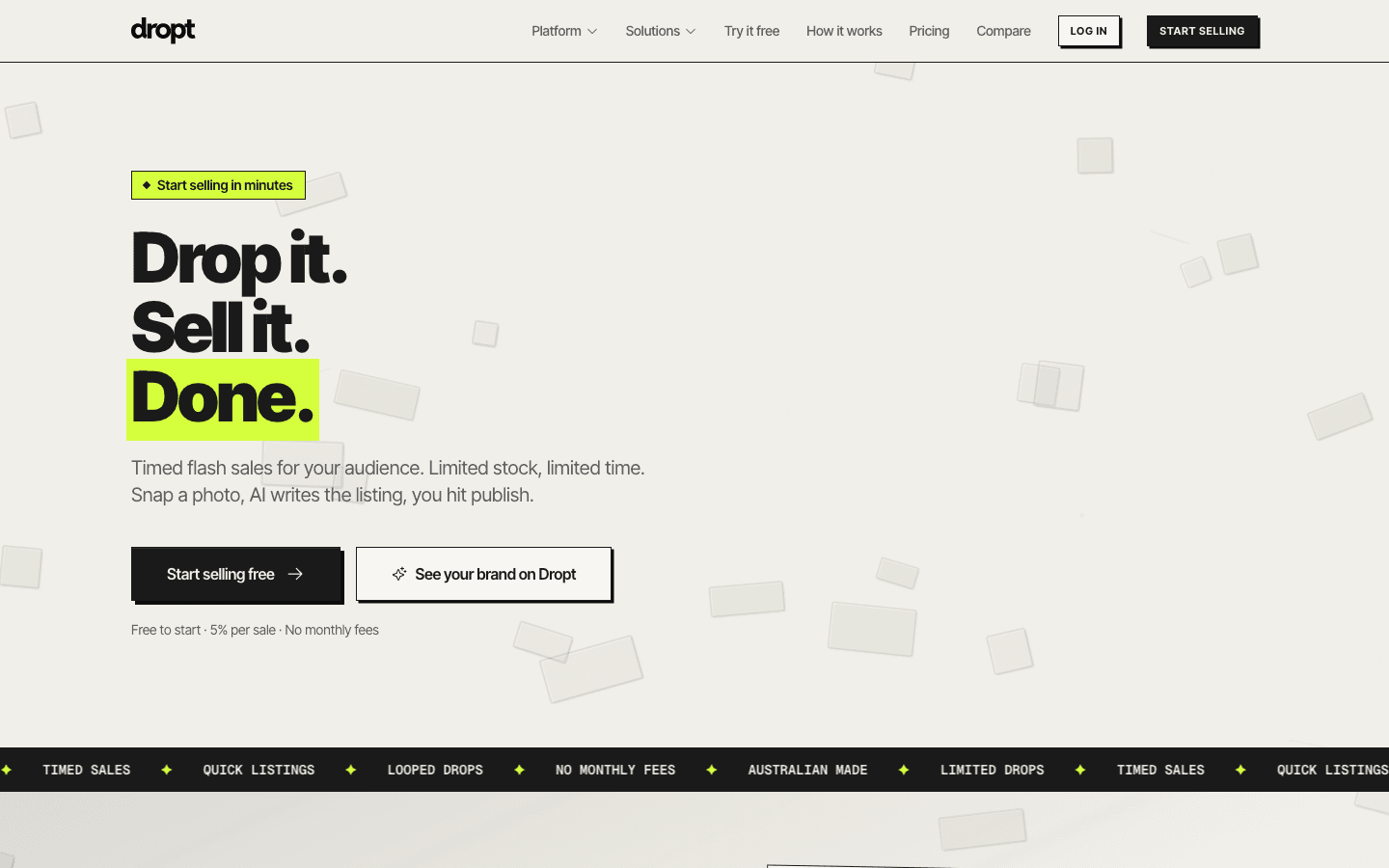
A full SaaS product: timed storefronts, AI-written listings, live pricing and signups — end to end.
Sellers snap a photo, AI writes the listing, and the sale goes live in minutes.
When we're not the answer
If you have steady, full-time work for two or more developers for the next two years, hire them. It's cheaper and the knowledge stays in the building, and we'll help you interview. If the budget is a few thousand dollars, a good freelancer or an off-the-shelf product beats a team. And if you already have a strong team and things still aren't shipping, what you probably need is a fractional CTO, not more hands.
Start with a conversation
An hour on where you are and what's in front of you. You'll leave with a straight answer on whether this is the right shape, and the monthly figure if it is.
Common questions
Small by design: typically a lead, one or two senior developers and a product designer, drawn from a core we've worked with for years and a network of specialists we bring in for particular work such as mobile, 3D or data. You meet the people doing the work before anything starts, and they don't change without telling you.
Yes. A standing team stays the same team. If someone is away, the lead tells you in advance and the work is covered by someone who already knows the codebase, because nothing on our side lives in one person's head.
The Macedon Ranges, an hour from Melbourne, working on Australian Eastern time with businesses across the country. Most work is remote; we come to you for kick-offs and the moments that go better in a room. Being in your time zone and your legal system is a large part of the point.
Yes, and it's common. We join your repositories, your planning and your review process, and we're careful about the handover: shared conventions, documentation, and no clever dependencies on us. The aim is that your team is stronger when we leave, not dependent.
Mostly TypeScript: Next.js and React on the front, Node and Postgres behind it, usually on Supabase and Vercel or AWS, with native mobile where the product needs it. We choose boring, well-supported technology on purpose, so any competent developer can pick it up after us.
A fixed price for a project with defined edges, or a fixed monthly fee for an agreed block of days, month to month. Small ongoing care runs on a retainer from $750 a month. We don't publish a day rate; you get the number on the first call, in writing, before anything starts.
You keep everything, because it was always yours: repositories, hosting, accounts, documentation. We hand over to whoever comes next, whether that's an in-house hire or another firm, and we'll help you find them. There's no exit fee and nothing that only works while we're around.
The kind of thing we build
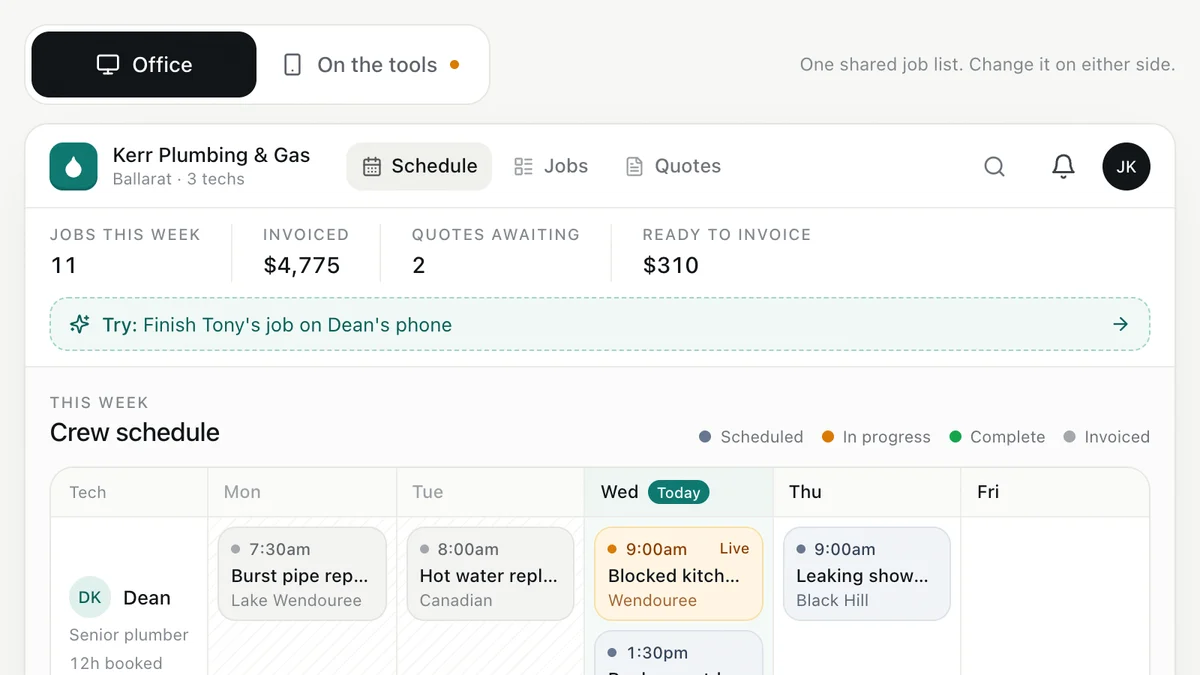
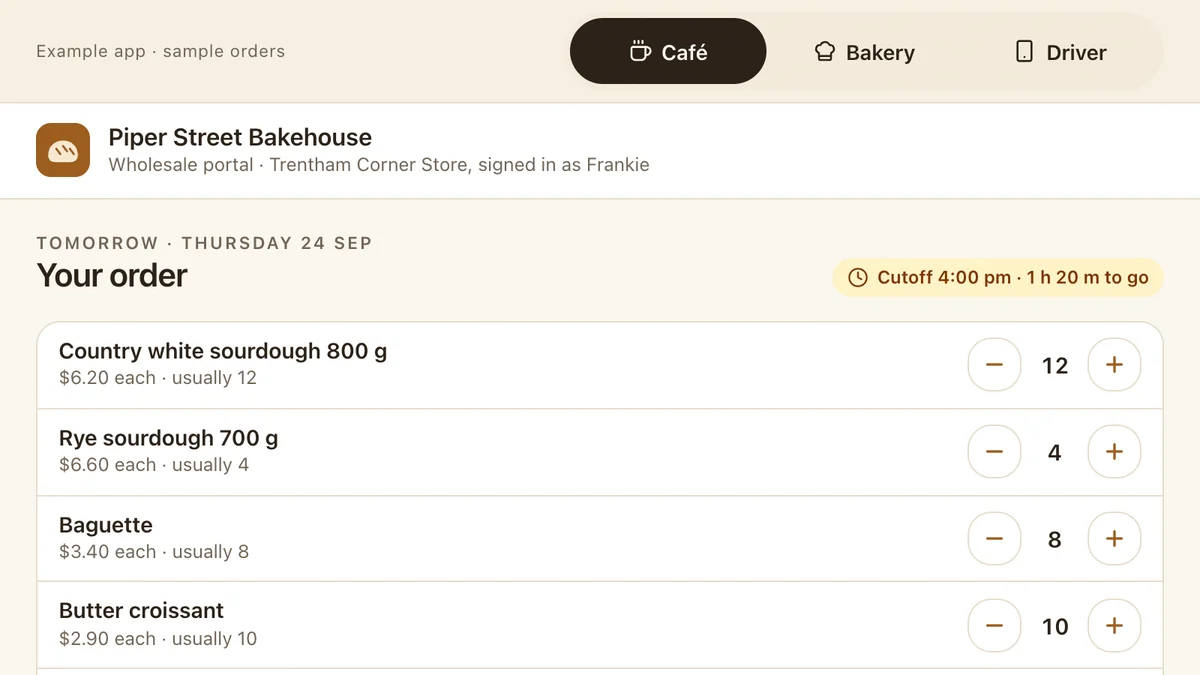
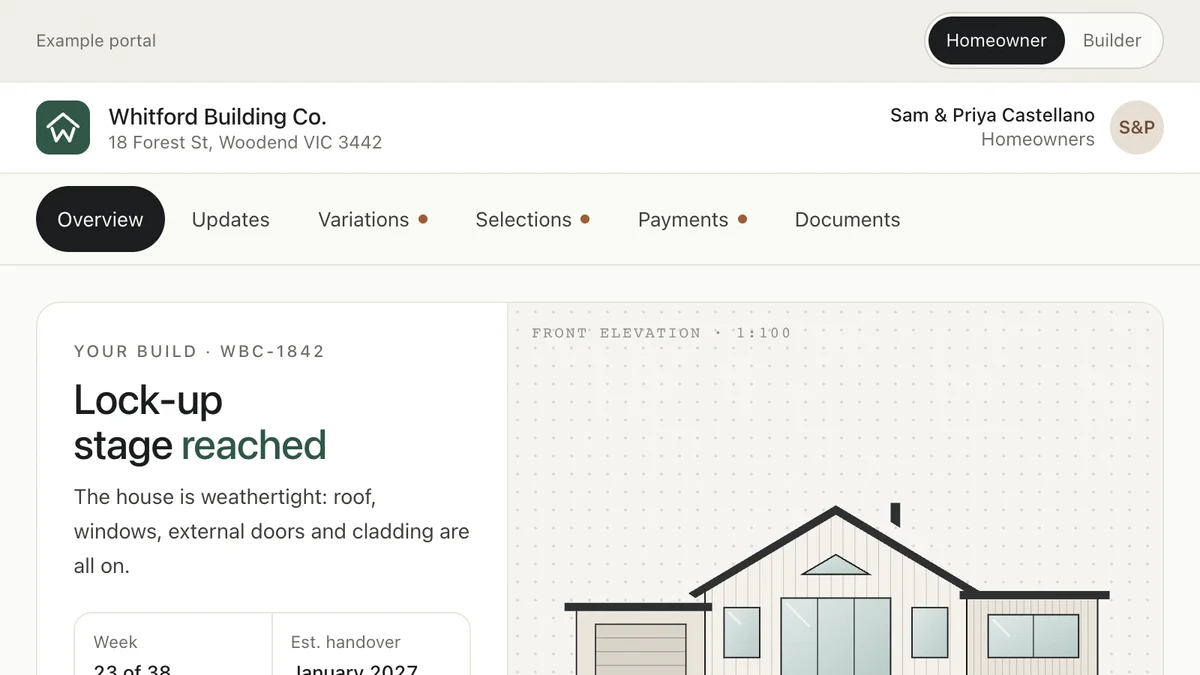
Working software, running with a fictional business and sample data. Use it, then decide.
Also worth a look
- A fractional CTO for companies that can't yet justify a full-time one
- Senior product design, a few days a month, inside your team
- Freelancer, agency or in-house: the trade-offs
- Offshore vs local, honestly
- What an app actually costs in Australia
Last reviewed . Market figures are indicative Australian ranges, not our prices. Our fee is fixed in writing on the first call.