AI in practice
AI scribes, AI admin and what Ahpra, the TGA and the OAIC say
The TGA counted about 100 AI scribe suppliers in Australia, and the rules around them moved in 2026. The TGA found most of the scribes it examined probably include medical-device functions, the RACGP wrote AI into its practice standards, and privacy policies gain a new disclosure duty in December. In our view the lower-risk uses sit on the admin side: enquiries, reminders and intake. This page sets out the positions and where the line falls.
Rather just ask someone? Talk to usIn short
Practitioners stay accountable for anything an AI tool produces. Ahpra expects informed consent before an AI scribe records a consultation, ideally noted in the record. The TGA's October 2026 review found 8 of 12 scribes examined likely included medical-device functions. In our view, admin uses such as sorting enquiries, sending reminders and summarising intake forms carry less regulatory risk than clinical ones, though the Privacy Act still applies to them.
General information about systems and processes, current as at November 2026. It isn't legal, clinical or compliance advice: check how the rules apply to your practice with your National Board, professional body, indemnity insurer or adviser.
- What is an AI scribe?
- Software that listens to a consultation, transcribes it and drafts the note, letter or summary for the practitioner to check. The TGA calls them digital scribes. One that only records, transcribes, translates or summarises, without adding clinical content, isn't a medical device. One that suggests diagnoses, treatments or investigations, triages patients or generates clinical conclusions probably is.
What actually works
You stay accountable for every note
Ahpra's AI guidance (22 August 2024) applies the existing Code of Conduct to AI rather than adding new rules. The practitioner remains responsible for safe care whatever tool is used, must apply human judgement to any AI output, and must check the accuracy and relevance of records a scribe creates. TGA approval of a tool doesn't change that. Ahpra also expects you to understand the tool: its intended use and limitations, how it was tested, where data is stored, and whether patient data is used to train it. Check with your indemnity insurer that its use is covered.
Consent before recording
Ahpra says to get informed consent for AI scribes, ideally note the patient's response in the record, and warns there may be criminal implications if consent isn't obtained before recording. It also says the software should ask for consent as its first step. The RACGP advises asking at the start of each consultation, notes some medical defence organisations advise written consent, and points to state and territory surveillance devices laws. The TGA says patients can withdraw consent at any time and, if they ask, should be offered another way to record the consultation. The ACSQHC suggests telling patients early, through waiting-room posters, registration forms or the booking process, which an online booking and intake flow can do.
The TGA has changed the answer on scribes
Ahpra (2024) and the RACGP (June 2026) both said scribes generally aren't TGA-regulated. The TGA's review, published 16 October 2026, identified about 100 suppliers, received survey responses from 40 and reviewed 12 products in detail. Eight likely included medical-device functions, two needed more information and two appeared unlikely to be devices. None of the 12 suppliers called its product a device, and the TGA didn't say which were which. A 'not for diagnosis' disclaimer doesn't take a product out of regulation, and an update that adds a diagnostic or treatment feature can turn a scribe into a device. Ask your vendor what its intended purpose is, whether it's in the ARTG, and recheck after each major update.
Know where the audio and notes go
The OAIC's guidance on commercial AI products says privacy obligations apply to what goes into an AI system and what comes out, that recordings often contain sensitive information needing consent, and that consent can't be implied just because a patient was notified. AI-generated errors about a patient are still personal information. The RACGP says to check whether scribe data is processed or stored overseas, avoid vendors who can't give assurances about Australian legal obligations, and update your privacy policy to disclose scribe use. The ACSQHC goes further: its position is that scribe data be stored and processed in Australia unless the patient explicitly consents otherwise.
The RACGP Standards now include AI
The 6th edition of the RACGP Standards for general practices, released 26 August 2026, adds criterion F11 on AI. Practices using AI need processes to obtain and document informed consent, de-identification where possible, governance, clinical oversight of outputs, and evaluation before and after a tool goes in. Practices stay responsible for third-party tools such as scribes. If a patient withdraws consent, the practice documents it, stops using AI in their care unless clinically necessary and re-authorised, and offers a non-AI alternative. It's written for general practice, but allied health and specialist practices can use the same structure.
The front desk: the lower-risk place to start
In our view, the admin around care is the lower-risk place to start with AI. The Privacy Act still applies to everything a patient sends. AI can sort enquiries by type (new patient, reschedule, fees, referral questions) and draft replies for staff to check. It can send appointment reminders, which the ACMA says generally aren't spam as long as they carry no promotional content and no links to it. It can turn a patient's intake answers into a tidy summary the practitioner reads before the first appointment. The line to hold is the one the TGA draws for scribes: restate what the patient or practitioner said, but don't suggest a diagnosis or rank patients by clinical urgency. Any public-facing chatbot should be clearly identified as AI, the OAIC says.
Get ready for 10 December 2026
From that date, privacy policies must disclose where a computer program, including AI, makes or substantially and directly informs decisions that could significantly affect people, with the kinds of information used and decisions made. The OAIC doesn't address scribes specifically, and whether a tool is caught depends on the decisions it informs. Separately, the OAIC recommends as best practice that personal information, especially health information, never goes into publicly available generative AI tools. List every AI tool staff use, including the free ones, before updating the policy.
Where common AI uses sit
Our summary, based on the TGA's digital scribe guidance and the Ahpra, RACGP, ACSQHC and OAIC positions above. It's a starting point for your own assessment, not a ruling.
| Criteria | Where it sits | What to check |
|---|---|---|
| Sorting enquiries and drafting replies | Admin. Privacy rules apply to what patients send. | A person sends anything clinical; a public chatbot is labelled as AI. |
| Appointment reminders | Admin. Generally not spam if purely factual. | No promotions or links to them inside the reminder. |
| Summarising intake forms | Admin, if it only restates what the patient wrote. | No suggested diagnoses or clinical prioritisation. |
| Scribe that only records, transcribes and summarises, adding no clinical content | Not a medical device under TGA guidance. Consent and privacy rules apply. | Consent before recording (the RACGP advises asking at each consultation), check every note, know where audio is stored. |
| Tool that suggests diagnoses, treatments or tests, or triages patients | Likely a medical device that must be in the ARTG unless exempt. | Ask the vendor for its ARTG status; recheck after updates. |
| Patient details in a public chatbot | The OAIC recommends against it as best practice. | Use tools whose data use and location you've checked. |
Questions to ask an AI scribe vendor
Drawn from what Ahpra, the TGA and the RACGP expect a practice to know before using a scribe.
- What is the product's intended purpose, and is it included in the ARTG? If not, why not?
- Does any feature suggest diagnoses, treatments or investigations, or prioritise patients?
- Where is audio and text stored and processed, including by subcontractors?
- Is our patients' data used to train or retrain the model?
- Does the software ask for consent as its first step, and record the answer?
- How do we switch it off for a patient who declines or withdraws consent?
- Does it write into our practice software's fields, or will staff re-enter notes?
- How will we be told when an update adds new functions?
- Has our indemnity insurer confirmed we're covered to use it?
Where we'd tell you otherwise
We don't build AI scribes or anything that suggests diagnoses, treatments or clinical priorities; that's medical-device territory and belongs with a specialist vendor. If you want a scribe, choose one on the market and put the questions on this page to it. Where we help is the admin around care: enquiries, reminders, intake and, where the vendor allows, getting data into your practice software, with a person checking anything that reaches a patient.
Tell us how your practice runs
Describe the practice software you use and where time goes: phones, intake forms, re-typing, no-shows or the website. We'll tell you what we'd do first, including when the answer is a setting in software you already pay for.
jayson@pixelapps.com.au
1300 204 802
Macedon Ranges, Victoria
Serving clients across Australia
Common questions
Some are. The TGA says a scribe that only records, transcribes or summarises isn't a medical device, but one that suggests diagnoses, treatments or investigations, triages patients or generates clinical conclusions likely is. Its October 2026 review found 8 of 12 scribes examined likely had device functions, though none of their suppliers called them devices. Earlier Ahpra and RACGP statements that scribes generally aren't regulated predate that review.
Ahpra asks for informed consent and ideally a note of the patient's response in the record. The RACGP advises getting consent at the start of each consultation and notes some medical defence organisations advise written consent. The RACGP notes that in some jurisdictions recording a private conversation without consent is a criminal offence, and points to state and territory surveillance devices laws, so ask your defence organisation or insurer what they expect, and give patients a way to say no without awkwardness.
Not with patient details in a publicly available tool. The OAIC recommends, as best practice, that organisations don't enter personal information, and particularly sensitive information, into publicly available generative AI. If AI drafts letters, use a tool whose data handling and location you've checked, keep identifying details out where you can, and have the practitioner check every draft.
Very likely. The OAIC says organisations should update privacy policies and notices to explain their AI use, and the RACGP says practices using scribes need to disclose them. From 10 December 2026, the policy must also cover programs that make or substantially inform decisions significantly affecting people. Privacy Commissioner Carly Kind said in May 2026 that the OAIC is tracking the rollout of AI scribes closely, and noted civil society concerns about scribes going undisclosed in privacy policies.
It can handle admin: hours, fees, how to book, what to bring, which practitioner sees what. The OAIC says public-facing AI tools should be clearly identified as AI. Anything clinical, such as whether a symptom needs seeing, should go to a person, which also keeps the tool on the admin side of the line the TGA draws.
It depends on the channels, the practice software it connects to and how much a person reviews, so it's quoted. Custom work is quoted individually, at a fixed price agreed before anything starts. Ongoing support and tuning is a retainer from $750 per month. If you just need a clear practice website first, the Small Business Plan is $950 setup, then $95/month.
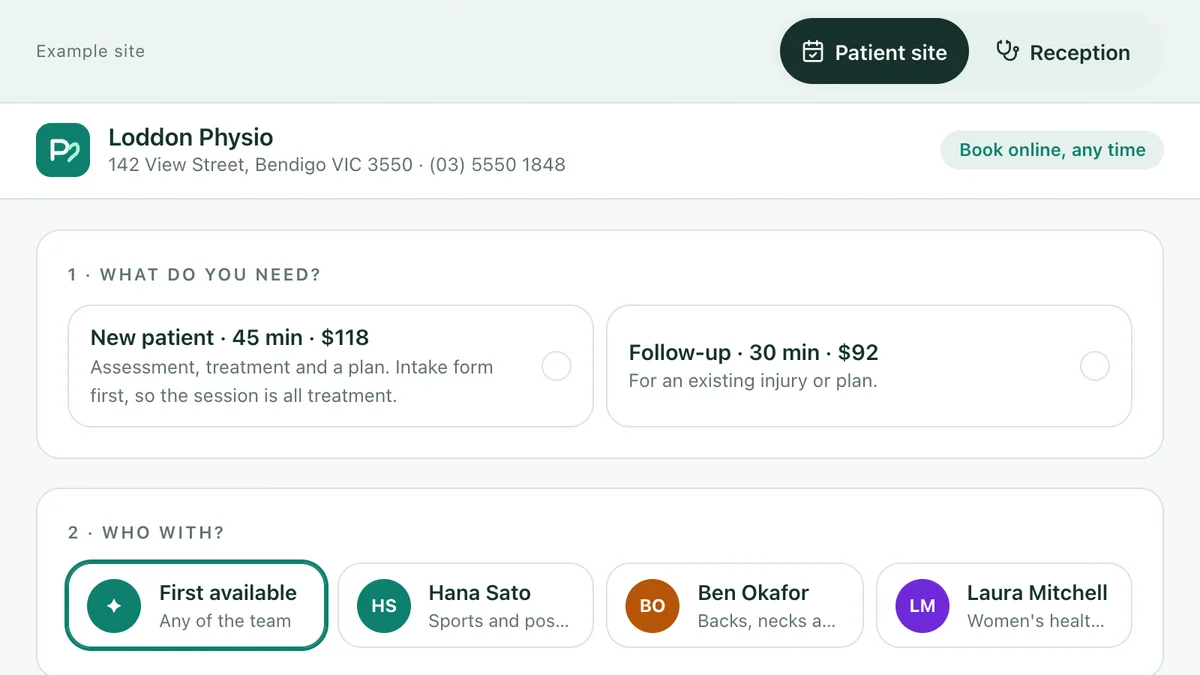
See it working
Software we'd build, running with a fictional business and sample data. Use it, then decide.
Also worth a look
- Patient Privacy for Australian Health Practices
- Software and Websites for GP Clinics
- Software for Psychology and Counselling Practices
- Online Booking for Clinics: Built-in, Marketplace or Custom
- Holding patient records? Security reviews for code, cloud and integrations
Last reviewed . General information, not legal, clinical or compliance advice. Prices are indicative Australian ranges, not quotes.