Online booking
Online booking that books the right appointment type
Many clinics already take bookings online somehow: the booking page that comes with their practice software, a listing on HotDoc or HealthEngine, or both. The trouble is in the details. New patients book a follow-up slot and referral patients turn up without the referral. A no-show fee nobody mentioned at booking is hard to charge, reminder texts drift into marketing, and some time pickers don't work with a screen reader. This guide covers the three ways to take bookings and the rules that shape each one.
Rather just ask someone? Talk to usIn short
Start with your practice software's own online booking if it has one, because your appointment types, practitioners and availability already live there. Add HotDoc or HealthEngine if you want their patient traffic. Build a custom front end only when you need routing, referral capture or intake the others can't do, and only where your software's API allows it.
General information about systems and processes, current as at November 2026. It isn't legal, clinical or compliance advice: check how the rules apply to your practice with your National Board, professional body, indemnity insurer or adviser.
- What is a custom booking front end?
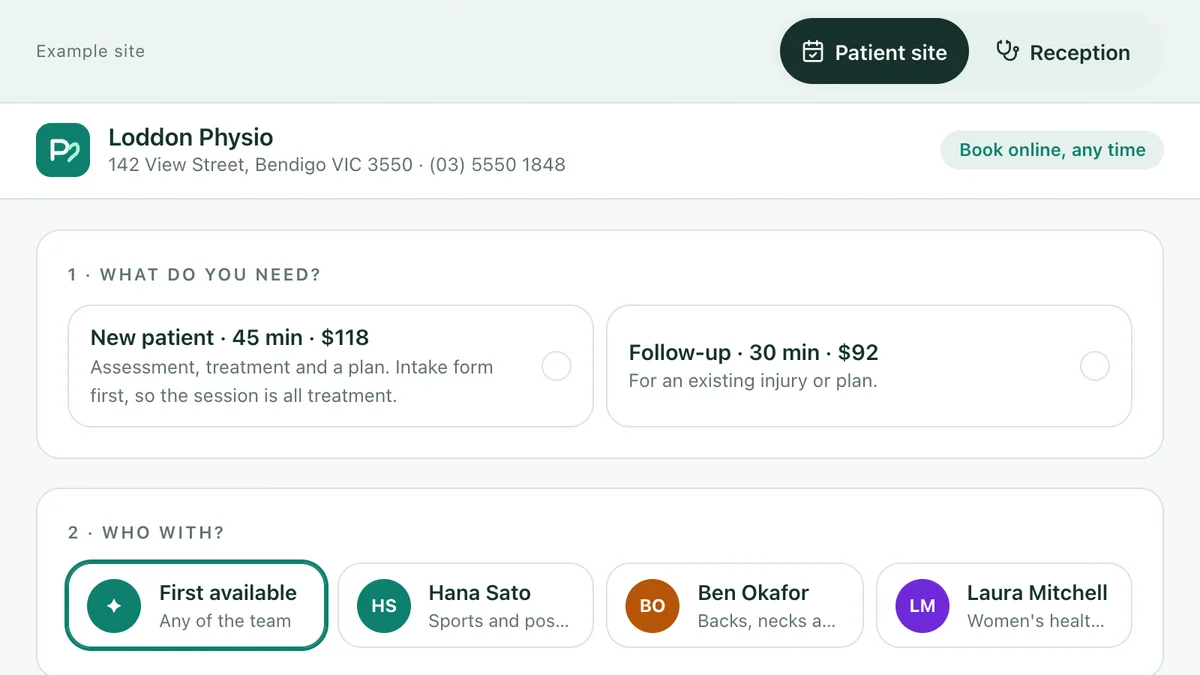
- A booking page built for your clinic that reads live availability from your practice software and writes the appointment straight back into it. The diary stays in your practice software. The front end adds the questions, routing and intake the software's own booking page can't, such as sending a new patient with a GP referral to the right appointment type.
Numbers that shape a booking flow
From Medicare, DVA, Services Australia and ACMA sources, checked November 2026. Check the current source before you rely on any of them.
- GP chronic condition management plan Up to 5 services a year
- Medicare allied health services per calendar year under a GP chronic condition management plan; 10 for Aboriginal and Torres Strait Islander patients. Resets on 1 January.
- DVA allied health referral 12 sessions or 1 year
- Whichever ends first. The provider then sends an end-of-cycle report to the client's usual GP.
- Better Access initial referral Up to 6 sessions
- Out of up to 10 individual Medicare mental health sessions a calendar year.
- Medicare benefit on a missed-appointment fee None
- Benefits aren't payable for services not provided, including charges for cancelled or missed appointments.
- Unsubscribe deadline for commercial messages 5 working days
- Applies to any SMS or email that promotes a service, including a reminder with an offer added.
- Unregistered branded SMS sender IDs 'Unverified' since 1 July 2026
- Shown instead of your clinic's name unless the sender ID is on the SMS Sender ID Register.
What actually works
Your practice software's booking comes first
Your appointment types, lengths, rosters and practitioner availability already live in your practice software, whether that's Cliniko, Nookal, Halaxy, Coreplus, Splose or Zanda (formerly Power Diary). If it offers an online booking page, configure it fully before you look further: which practitioners offer which types, which types a new patient can book, buffers between appointments, and how far ahead people can book. One diary means no syncing and no double bookings.
Marketplaces add discovery, on their terms
HotDoc and HealthEngine list your clinic where patients search for one. HealthEngine offers practices bookings, recalls, reminders, intake forms and payments across general practice, dental, allied health and specialists. HotDoc publishes integrations with Best Practice, ZedMed and MedicalDirector for GPs and with Centaur's Dental4Windows and Dental4Web, and Cliniko lists it as a connected app. Coreplus lists booking integrations with both. You get reach; in return your listing sits beside other clinics. Under Ahpra's guidance the platform owner is responsible for its review function, and you're responsible for the content you control there.
Check the API before planning anything custom
A custom booking page is only as good as its connection to your diary. Cliniko has a public REST API, and each key carries the permissions of the user it belongs to, so give it a user set up for the purpose. Nookal lets you create keys limited to chosen locations and access levels. Halaxy's FHIR API is a paid subscription of 150 credits a month and includes webhooks. Coreplus reviews add-ons before production, Splose issues keys to the account owner on approval, Zanda's API is still in closed beta and Jane has no open API. Where the vendor allows it, we build; where it doesn't, we say so.
Appointment types and new patients are where booking goes wrong
A new patient who books a 30-minute follow-up arrives into a slot too short for an initial assessment, and the day runs late. Ask 'have you been here before?' first, offer only the types that fit the answer, and size slots by type and practitioner. Referral patients need their own path. A patient on a GP chronic condition management plan can get up to 5 Medicare allied health services a calendar year, and each one needs a referral. The limit belongs to the patient, not the referral. A DVA referral covers up to 12 sessions or a year. So the booking should ask for the referral, and reception should ask how many Medicare services the patient has already used this year.
Deposits and no-show fees: say them before the booking is confirmed
Medicare pays nothing for an appointment that didn't happen, so a missed-appointment fee is a private charge with no rebate. A bulk-billed service can't carry extra charges at all, and the Department's guidance names 'a booking fee to be paid before each service'. Our reading is that a deposit on a bulk-billed appointment risks being that kind of charge, so check with your adviser before taking one. For private appointments, Ahpra's shared Code of conduct asks the professions it covers to discuss fees before the service where possible and to be honest and transparent about money. Show the cancellation policy on the booking page, have the patient accept it, and keep that record with the booking.
Keep reminders factual and register your sender ID
The ACMA says appointment reminders are generally not spam. Add a promotion, or a link to one, and the whole message can become commercial, which then needs consent, sender details and an unsubscribe actioned within 5 working days. Send reminders and marketing separately. The OAIC says consent can generally be implied for reminders to attend a booked appointment, and even for a reminder that a fee may apply after a previous no-show, but promotions sent to your whole patient list generally need express consent. Since 1 July 2026, texts from an unregistered branded sender ID show 'Unverified' instead of your clinic's name.
Booking pages carry health information and should work for everyone
The OAIC treats appointment details collected while providing a health service as health information, and says organisations must generally make sure sensitive information isn't disclosed to third-party platforms through tracking pixels. Keep advertising pixels off booking and intake pages. The Australian Human Rights Commission's 2025 guidelines, which use seeking medical services as an example of digital access, say organisations should meet WCAG 2.2 Level AA at a minimum. For booking, that means time pickers that work by keyboard and screen reader, labelled fields and error messages that say what to fix.
Three ways to take bookings online
The first is the place to start. The second and third are additions, and they can sit side by side.
| Criteria | Practice software's own booking | Marketplace (HotDoc, HealthEngine) | Custom front end |
|---|---|---|---|
| Where appointments live | In your practice software, directly | In your practice software, where the marketplace integrates with it | In your practice software, through the vendor's API |
| Who finds you | People who already know your clinic | Also people searching the platform for a clinic nearby | People who already know your clinic, via your website and Google Business Profile |
| Intake and screening | Whatever forms your software offers | Depends on the platform; HealthEngine offers intake forms | Built to your appointment types, referral rules and screening questions |
| Patient reviews | Depends on the software | On the platform, which is responsible for its review function | None, unless you add them (clinical testimonials are out for registered professions) |
| Cost shape | Set by your software vendor | The platform's own fees | A fixed-price build, plus any API charge from your software vendor |
| Best when | Your appointment types are simple and the built-in rules cover them | You want extra patient discovery and accept a shared listing | Booking needs routing, referrals or intake the others can't do |
Where we'd tell you otherwise
If your practice software's own online booking handles your appointment types and new-patient rules, use it and stop there; it's cheaper and one less system. We're not a booking marketplace and don't bring patient traffic. We also don't set your fee policy or give Spam Act advice: we build the booking and reminder flow around the rules your adviser and your software set.
Tell us how your practice runs
Describe the practice software you use and where time goes: phones, intake forms, re-typing, no-shows or the website. We'll tell you what we'd do first, including when the answer is a setting in software you already pay for.
jayson@pixelapps.com.au
1300 204 802
Macedon Ranges, Victoria
Serving clients across Australia
Common questions
They do different jobs. Your practice software's booking page takes bookings from people who already want you. A marketplace adds people searching its platform, in a listing beside other clinics and under the platform's terms. You can run both. If you list on one, check that it integrates with your practice software so you aren't keeping two diaries.
Practices can for private appointments, but the patient should know before they book: show the policy on the booking page and record that they accepted it. There's no Medicare benefit on a missed-appointment fee, and a bulk-billed service can't carry a booking fee or other extra charge. Since 9 November 2023, unfair terms in standard form consumer contracts have been illegal and can attract penalties. No regulator guidance we found deals with clinic cancellation fees specifically, so have your adviser look over the wording.
Usually not. The ACMA says appointment reminders are generally not spam, and a purely factual message is exempt from the consent and unsubscribe rules, though it must still identify your clinic. Add a promotion, or a link to one, and the message can become commercial. Then you need consent and a working unsubscribe. Keeping reminders and marketing separate avoids the question.
Since 1 July 2026, SMS sent under a branded sender ID that isn't on the SMS Sender ID Register display 'Unverified' instead of the brand name, grouped with other unregistered senders. Register the sender ID through your telco or messaging provider. If your practice software sends the texts, ask the vendor how its sender IDs are registered.
It depends on the vendor. Cliniko and Nookal publish APIs that practices can use, Halaxy's API is a paid subscription, Coreplus reviews add-ons before production and Splose issues keys on approval. Zanda's API is in closed beta, and Jane has no open API and says it has no plans for one, so a custom front end that reads and writes the diary isn't possible on either today. We check this on the first call.
It depends on your appointment types, your practice software and how much intake and screening it carries, so we quote after a short call. Custom work is quoted individually, at a fixed price agreed before anything starts. Ongoing support is a retainer from $750 per month. If you only need a clinic website that links to your existing booking page, the Small Business Plan is $950 setup, then $95/month.
See it working
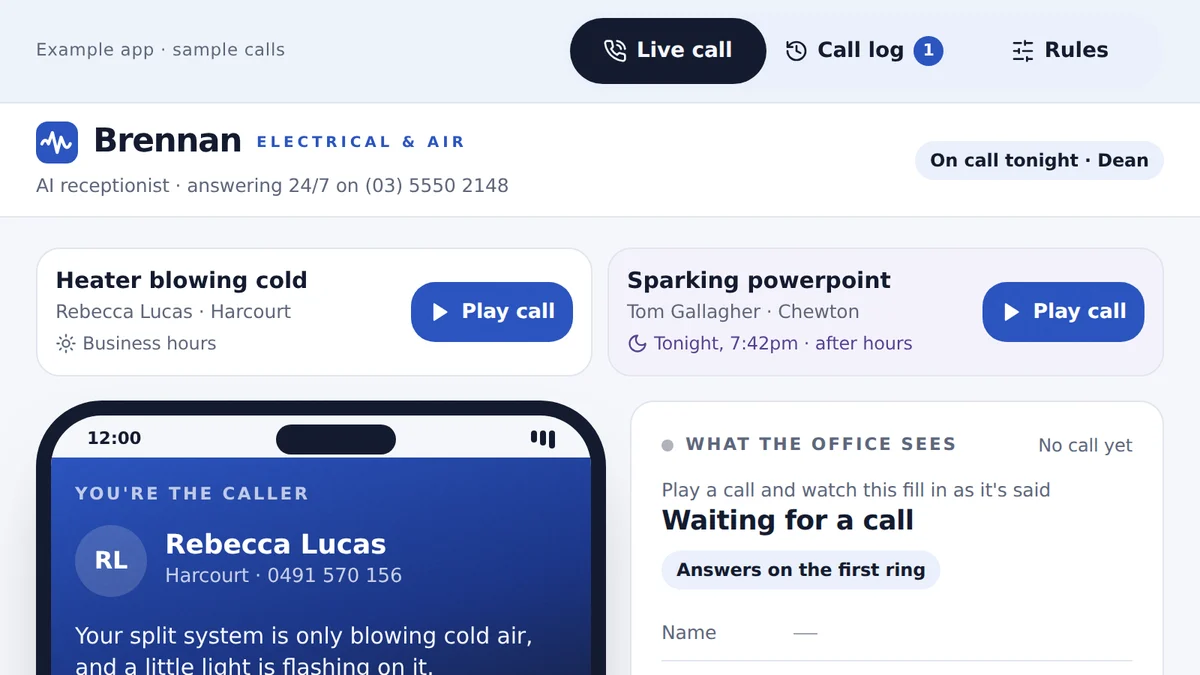
Software we'd build, running with a fictional business and sample data. Use it, then decide.
Also worth a look
- Websites for Health Practices in Australia
- Patient Privacy for Australian Health Practices
- Booking, Intake and Software for Physio Clinics
- Software and Websites for GP Clinics
- Holding patient records? Security reviews for code, cloud and integrations
Last reviewed . General information, not legal, clinical or compliance advice. Prices are indicative Australian ranges, not quotes.