General practice
Booking, recalls and websites built around Best Practice and MedicalDirector
General practices run on clinical software: Best Practice's Bp Premier, MedicalDirector Clinical with Pracsoft or the cloud-based Helix, or ZedMed. HotDoc says it integrates with Best Practice, ZedMed and MedicalDirector, and HealthEngine is another national booking marketplace. Since 2025 the admin around that software has grown: MyMedicare shaping telehealth and care plans, new chronic condition management items, wider bulk billing incentives, and now AI scribes and an RACGP criterion on AI.
Rather just ask someone? Talk to usIn short
A GP clinic's builds belong beside Best Practice or MedicalDirector, never inside them: booking and pre-visit forms that respect the MyMedicare telehealth rule, recall lists for chronic condition management plans, a website that states billing plainly, and consent records for AI scribes under the RACGP's new 6th edition AI criterion.
General information about systems and processes, current as at November 2026. It isn't legal, clinical or compliance advice: check how the rules apply to your practice with your National Board, professional body, indemnity insurer or adviser.
- What is a GP chronic condition management plan?
- The plan that replaced GP Management Plans and Team Care Arrangements on 1 July 2025. A GP prepares it under MBS item 965 (or 92029 by video) and reviews it under 967 (or 92030 by video). A patient needs one prepared or reviewed in the previous 18 months to keep using MBS allied health services.
GP numbers and dates worth knowing
From the MBS, the Department of Health, Disability and Ageing and the Australian Digital Health Agency, current as at November 2026.
- Chronic condition plan items 965 / 967
- Prepare and review, face to face. By video: 92029 and 92030. In place since 1 July 2025.
- MBS allied health services 5 a year
- Individual services per calendar year on a plan; 10 for Aboriginal and Torres Strait Islander patients.
- Plan currency for allied health 18 months
- The plan must have been prepared or reviewed within this window.
- Old GPMP and TCA plans 30 June 2027
- Last day plans made before 1 July 2025 can be used.
- Telehealth relationship 12 months
- Face-to-face service by the GP or practice, unless the patient is MyMedicare-registered with the practice or an exemption applies.
- Bulk Billing Practice Incentive 12.5%
- Quarterly, on MBS benefits from eligible services, split evenly between GP and practice.
- Share by Default upload 24 hours
- For pathology and diagnostic imaging reports, from 1 July 2026.
What actually works
Keep the clinical software at the centre
Best Practice's Bp Premier runs on Microsoft SQL Server. Its cloud product, Bp Omni, isn't available in Australia yet; Best Practice says its cloud journey starts with Best Practice Mobile in 2026. MedicalDirector, part of the Telstra Health group, sells cloud-based Helix plus server-based Clinical and Pracsoft. Third parties connect through Best Practice's Partner Network or, for Helix, Telstra Health's FHIR-based Smart API+. We build alongside, through those routes, never inside the clinical record.
Booking: use the connected marketplace first
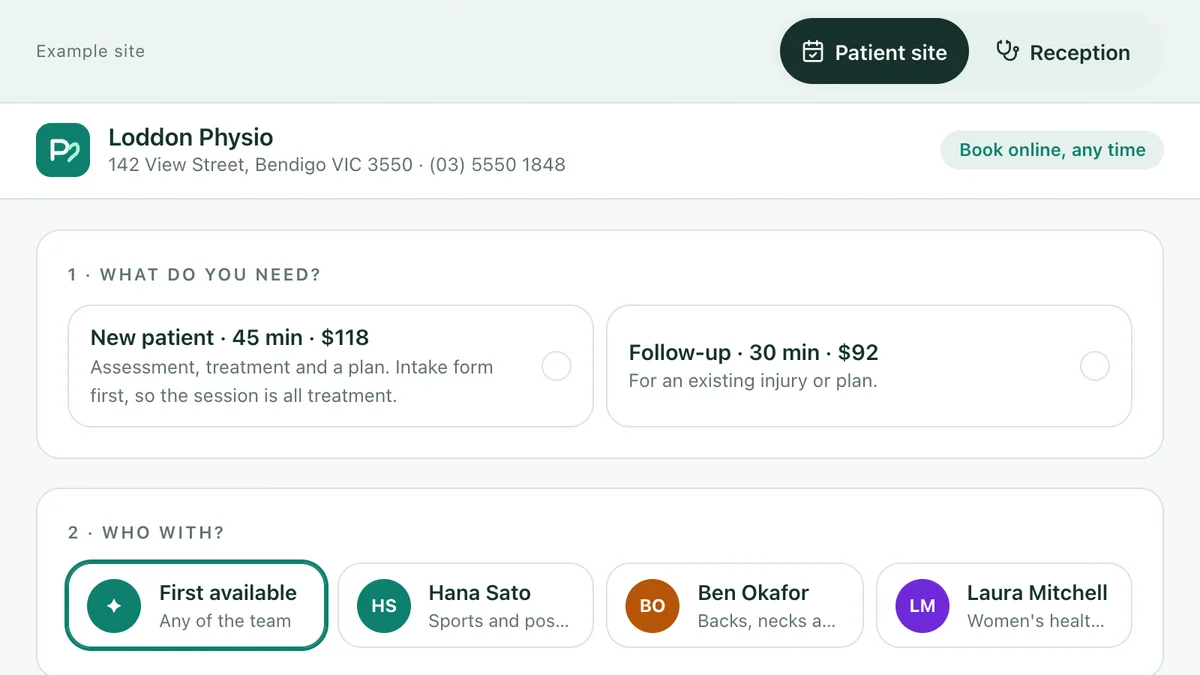
HotDoc integrates with Best Practice, ZedMed and MedicalDirector, and HealthEngine offers booking, recalls, reminders and intake forms for practices. If one already fills your books, keep it. A custom build fits before and after the booking: new-patient registration that arrives complete, questionnaires for long appointments, and routing that sends each patient to the right appointment type first time.
Telehealth booking that knows the 12-month rule
For non-referred GP telehealth items, the patient must be registered in MyMedicare with your practice, or have had a face-to-face service from the GP or the practice in the last 12 months; earlier phone or video consults don't count. There are exemptions, including children under 12 months and people experiencing homelessness, and the GP records them in the notes. A booking flow can ask the question up front and steer new patients to an in-person visit, leaving the clinical call to the GP.
Chronic condition plans need recall lists
On 1 July 2025, GP chronic condition management plans (items 965 and 967, plus video equivalents) replaced GP Management Plans and Team Care Arrangements. A plan can be prepared once every 12 months and reviewed every 3 months, and patients need one prepared or reviewed in the previous 18 months to keep using MBS allied health services. Plans made before July 2025 work until 30 June 2027. Recall lists drawn from your clinical data, where the vendor allows, put those dates in front of staff early.
Say plainly how you bill
Since 1 November 2025, bulk billing incentives apply to every Medicare-eligible patient. Practices in the Bulk Billing Practice Incentive Program get an extra 12.5% on eligible MBS benefits, split evenly between GP and practice, if they bulk bill every eligible service, are registered in MyMedicare, list as fully bulk billing in the National Health Services Directory, display signage and register through Services Australia. Your website should say who you bulk bill. A bulk-billed service can't carry a booking fee, and Ahpra says an offer paid for through Medicare isn't free.
Share by Default puts more results in front of patients
Since 1 July 2026, pathology and diagnostic imaging providers must upload their reports to My Health Record within 24 hours. GPs aren't required to upload anything new, but patients now see most pathology and most limb X-ray results as soon as they're uploaded, and CT, MRI and ultrasound reports after a 5-day delay. The Australian Digital Health Agency suggests discussing report availability and follow-up when ordering. A short explainer at the point of request can tell patients what to expect.
AI scribes and the 6th edition standards
The RACGP's Standards for general practices, 6th edition, released 26 August 2026, add criterion F11 on artificial intelligence: documented informed consent, AI governance, clinical oversight of outputs, and assessing AI use before and after rollout. The RACGP says to get scribe consent at the start of each consultation and to update your privacy policy. From 10 December 2026, privacy policies must also disclose computer programs that make or substantially inform significant decisions. We build consent capture and an AI tools register, not the scribe.
Before you add an AI tool to the practice
Drawn from RACGP criterion F11, the RACGP's AI scribe guidance and the TGA's digital scribe guidance. A starting point for your own governance, not accreditation advice.
- The tool and its purpose are on a register of AI tools the practice uses
- You know where its data is processed and stored, including whether it leaves Australia
- Patients are asked for consent at the start of each consultation and the answer is recorded
- A patient can withdraw consent at any time, and there is a non-AI alternative
- A clinician reviews every output before it enters the record
- Your privacy policy names the tool's use, and from 10 December 2026 any significant automated decisions
- You've set a date to review how the tool is working after rollout
- You've asked the vendor whether the tool suggests diagnoses, treatments or investigations, or triages patients; the TGA says a scribe that does is likely a medical device
Where we'd tell you otherwise
If HotDoc, HealthEngine or your clinical software already cover booking, reminders and recalls, configure them properly before paying for anything custom. Cubiko, which connects to Best Practice and MedicalDirector, lists a chronic condition and mental health plan eligibility checker. We don't build clinical decision tools, write into the clinical record outside a vendor-approved route, or give Medicare billing advice.
Tell us how your practice runs
Describe the practice software you use and where time goes: phones, intake forms, re-typing, no-shows or the website. We'll tell you what we'd do first, including when the answer is a setting in software you already pay for.
jayson@pixelapps.com.au
1300 204 802
Macedon Ranges, Victoria
Serving clients across Australia
Common questions
No. We build around clinical software, never inside it. Best Practice works with approved integrators through its Partner Network, and Telstra Health's Smart API+ gives partners access to MedicalDirector Helix, and to Clinical case by case. Where a vendor route exists for what you need, we use it. Where it doesn't, we keep the tool separate rather than reach into your database.
Usually start with a marketplace that already talks to your clinical software; HotDoc integrates with Best Practice, ZedMed and MedicalDirector. Build custom only for what it can't do, such as MyMedicare-aware telehealth routing or questionnaires before long appointments. Under Ahpra's rules, the review function on a third-party booking site is the site owner's responsibility, but anything you post there yourself is yours.
It can ask whether the patient is registered in MyMedicare with you or has been seen in person in the last 12 months, and steer them to a face-to-face booking if not. It shouldn't decide exemptions: the GP makes that call and documents it in the clinical notes, as MBS note AN.1.1 requires.
Criterion F11 expects documented informed consent, AI governance, clinical oversight of outputs, and evaluation before and after you adopt a tool. Practices stay responsible for third-party tools such as scribes, and patients can withdraw consent at any time. Ask your accrediting agency when your practice will be assessed against the 6th edition.
Not as a general practice, as at November 2026. The requirement covers pathology and diagnostic imaging reports, uploaded within 24 hours from 1 July 2026. The Australian Digital Health Agency says other information may be required later, after consultation. What matters for you is that patients may read results before you've called them.
Custom work is quoted individually, at a fixed price agreed before anything starts. A clinic with more than five staff gets its website quoted the same way; a solo GP or practice of 1 to 5 staff can use the Small Business Plan at $950 setup, then $95/month. Ongoing support for integrations and custom tools is a retainer from $750 per month.
See it working
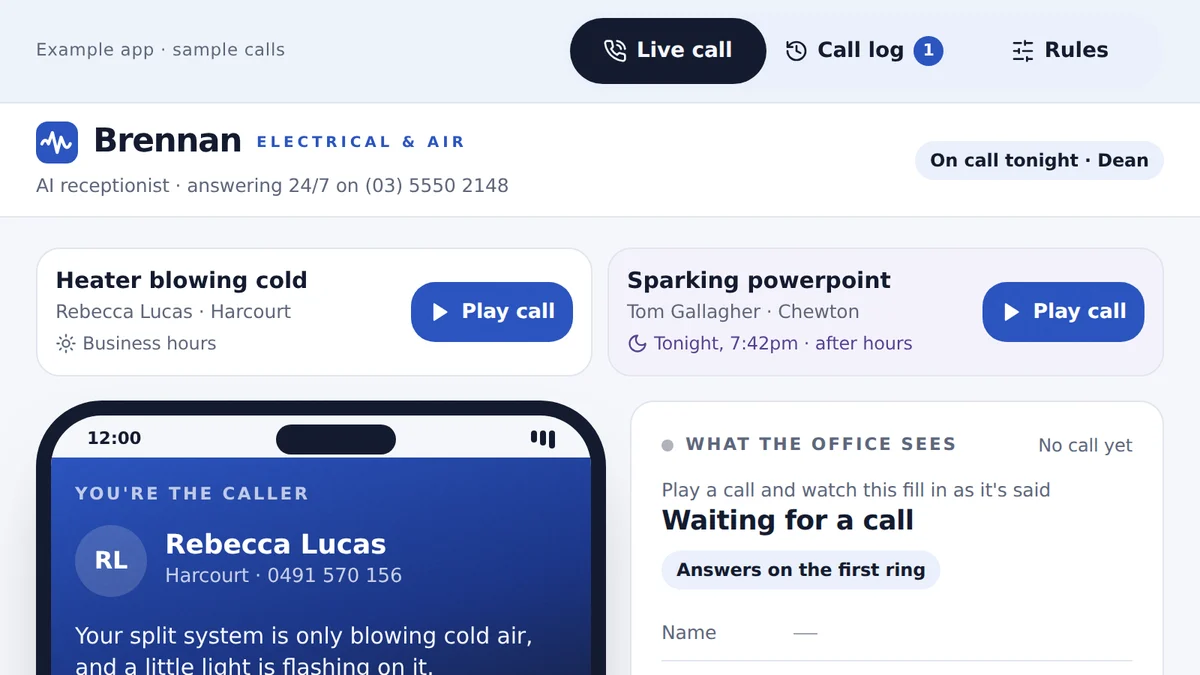
Software we'd build, running with a fictional business and sample data. Use it, then decide.
Also worth a look
- AI Scribes and AI Tools in Australian Practices
- Online Booking for Clinics: Built-in, Marketplace or Custom
- Patient Privacy for Australian Health Practices
- Software and Websites for Specialist Rooms
- Holding patient records? Security reviews for code, cloud and integrations
Last reviewed . General information, not legal, clinical or compliance advice. Prices are indicative Australian ranges, not quotes.