Psychologists and counsellors
Less referral admin, and reminders that give nothing away
If your practice runs Zanda (formerly Power Diary), Halaxy, Coreplus or Cliniko, the calendar already works. The admin happens around it. Someone has to check that a Better Access referral meets the current rules, count sessions against the referral and the calendar year, keep a waitlist that isn't a spreadsheet, and send reminders that don't tell whoever picks up the client's phone that they see a psychologist.
Rather just ask someone? Talk to usIn short
For a psychology practice, the admin around Zanda, Halaxy, Coreplus or Cliniko is where a build helps: referral intake that asks what the 1 November 2025 Better Access rules turn on and flags gaps for your team, session counts against the referral and the calendar year, a managed waitlist, and reminders worded to reveal nothing. Every field collected is sensitive health information.
General information about systems and processes, current as at November 2026. It isn't legal, clinical or compliance advice: check how the rules apply to your practice with your National Board, professional body, indemnity insurer or adviser.
- What makes a Better Access referral valid?
- For referrals written on or after 1 November 2025, Medicare pays Better Access psychological therapy benefits only where the referral comes from a GP or prescribed medical practitioner at the patient's MyMedicare registered practice, from their usual medical practitioner, or directly from a psychiatrist or paediatrician. The first referral covers up to 6 sessions. After that, the Mental Health Treatment Plan is reviewed and a new referral issued.
Numbers a psychology practice works to
From the MBS explanatory notes, the NDIS Pricing Schedule 2026-27 and OAIC data breach statistics, as at November 2026.
- Better Access sessions per calendar year Up to 10 individual
- Plus up to 10 group sessions. The count resets each calendar year.
- Sessions on the first referral Up to 6
- Then the Mental Health Treatment Plan is reviewed and a new referral issued. The plan itself doesn't expire.
- New referral rules apply from 1 November 2025
- Referral from the MyMedicare practice or usual medical practitioner, or a psychiatrist or paediatrician.
- NDIS psychologist price limit $252.99/hour
- Up from $232.99. Applies to NDIA-managed and plan-managed participants; remote +40%, very remote +50%.
- NDIS counsellor price limit $156.16/hour
- NDIS Pricing Schedule 2026-27, effective by Ministerial determination from 24 September 2026.
- Health sector data breach notifications 149 of 667
- January to June 2026. Health was again the top sector, with the most malicious attacks (72) and human-error breaches (62).
What actually works
Check the referral before the first session
Since 1 November 2025 it matters who wrote the referral, not just that one exists. An intake form can ask who referred the client (a GP at their MyMedicare practice, their usual doctor, or a psychiatrist or paediatrician) and when the letter was written, then take the letter as an upload. Anything that doesn't fit gets flagged to reception for a phone call before the client is booked in and out of pocket. The tool collects and flags; your team decides.
Count sessions two ways
Better Access allows up to 10 individual and 10 group sessions a calendar year, and the first referral covers at most 6. Practices need both counts visible: sessions left on this referral, and sessions left this year, including any the client had with another psychologist. A prompt at session 5 to request the GP review and new referral leaves time to get it before session 7. Psychologists are also eligible providers under GP chronic condition management plans, which allow up to 5 allied health services a calendar year.
Keep one waitlist
Enquiries arrive by phone, email and web form, and the waitlist ends up in three places. One list that records preferred times, practitioner preference, funding (Better Access, NDIS or private) and referral status lets reception find the right person when a cancellation comes up. It can also send people an honest update on where they stand.
Write reminders that say nothing clinical
The OAIC treats everything collected while providing a health service, appointment details included, as sensitive health information. A reminder can confirm a time and a practice name without naming the service or the practitioner's profession, from a sender name you choose with that in mind. Ask at intake whether texts and voicemails are safe for that client. Register your branded sender ID: since 1 July 2026, unregistered ones display as 'Unverified'.
Telehealth without hand-pasted links
Pasting a video link into an email by hand is how the wrong link reaches the wrong client, and health service providers reported the most human-error data breaches of any sector in January to June 2026 (62). A telehealth booking type that sends the session link to the confirmed contact on file, and records where the client will be for the session, takes that step out of reception's hands.
Psychologists and counsellors sit under different rules
Psychology is Ahpra-registered and 'psychologist' is a protected title. Counselling and psychotherapy are not regulated: anyone may use the titles, and PACFA and ACA standards bind only their members. A practice that advertises psychologists is advertising a regulated health service, so Ahpra's advertising rules apply. Clinical testimonials can't be used. Psychology has no recognised specialty, so nobody should be advertised as a 'specialist' or as 'specialising in' anything; Ahpra says 'substantial experience in' or 'working primarily in' is less likely to mislead. Your website should state each practitioner's profession plainly.
Treat AI notes as a consent question first
Ahpra says practitioners must get informed consent before using an AI scribe, ideally record the client's response, and that there may be criminal implications if consent isn't obtained before recording. The TGA says scribes that only record, transcribe or summarise aren't medical devices; ones that suggest diagnoses or treatments likely are. If you use one, build the consent step into the booking or intake so it's recorded before anything is.
Before a Better Access client's first session
What a referral intake should have collected, or flagged, before the client walks in or logs on.
- The referral letter is on file, with the date it was written
- The referrer is at the client's MyMedicare practice, is their usual GP, or is a psychiatrist or paediatrician
- Sessions on this referral and sessions already used this calendar year, including with other psychologists
- Whether it's safe to text, email or leave a voicemail for this client
- Consent recorded for telehealth and for any AI scribe, before the session
- Funding noted per client: Better Access, NDIS (and how the plan is managed) or private
Where we'd tell you otherwise
If Zanda, Halaxy, Coreplus or Cliniko already handles your bookings, reminders and intake forms well enough, configure it fully before paying for anything custom. We don't decide whether a referral is valid or a client is eligible; that stays with your team. We don't give advertising compliance sign-off, and we don't build tools that assess clients or suggest diagnoses or treatment.
Tell us how your practice runs
Describe the practice software you use and where time goes: phones, intake forms, re-typing, no-shows or the website. We'll tell you what we'd do first, including when the answer is a setting in software you already pay for.
jayson@pixelapps.com.au
1300 204 802
Macedon Ranges, Victoria
Serving clients across Australia
Common questions
No. We build what sits around them and connect to them where the vendor allows. The routes differ: Cliniko has a public REST API, Halaxy's FHIR-based API is a paid monthly subscription, Coreplus reviews add-ons before production use, and Zanda's public API was still in closed beta in November 2026. Which one you run shapes what's practical.
It can collect the referral, ask the questions that matter since 1 November 2025 (who wrote it, whether they're the client's MyMedicare practice or usual GP, when it was written) and flag anything that doesn't fit. It can't make the call for you. That stays with your team, and the rules themselves come from the MBS notes, not from us.
The OAIC says consent can generally be implied for reminders to attend a scheduled appointment, and the ACMA says appointment reminders are generally not spam. A promotion or a promotional link can make the message commercial, so keep reminders plain. The bigger risk is content: word reminders so they don't reveal the service, and ask each client at intake whether texts are safe.
Yes. Booking, intake, waitlist and reminders work the same way. What differs is regulation and funding. Counsellors aren't Ahpra-registered, and the NDIS price limit for counsellors is $156.16 an hour against $252.99 for psychologists. Set intake and billing up per practitioner type so each client sees the right options.
That's your clinical and professional decision. Ahpra requires informed consent and warns of possible criminal implications if you record without it, and the TGA says a scribe that suggests diagnoses or treatments is likely a medical device. Our guide to AI scribes covers the checks. What we can build is the consent step, recorded before any recording starts.
It depends on which practice software you run and how much of the referral and waitlist work you want automated, so we quote after a short call. Custom work is quoted individually, at a fixed price agreed before anything starts. A sole practitioner's website on the Small Business Plan is $950 setup, then $95/month; ongoing support for custom work is a retainer from $750 per month.
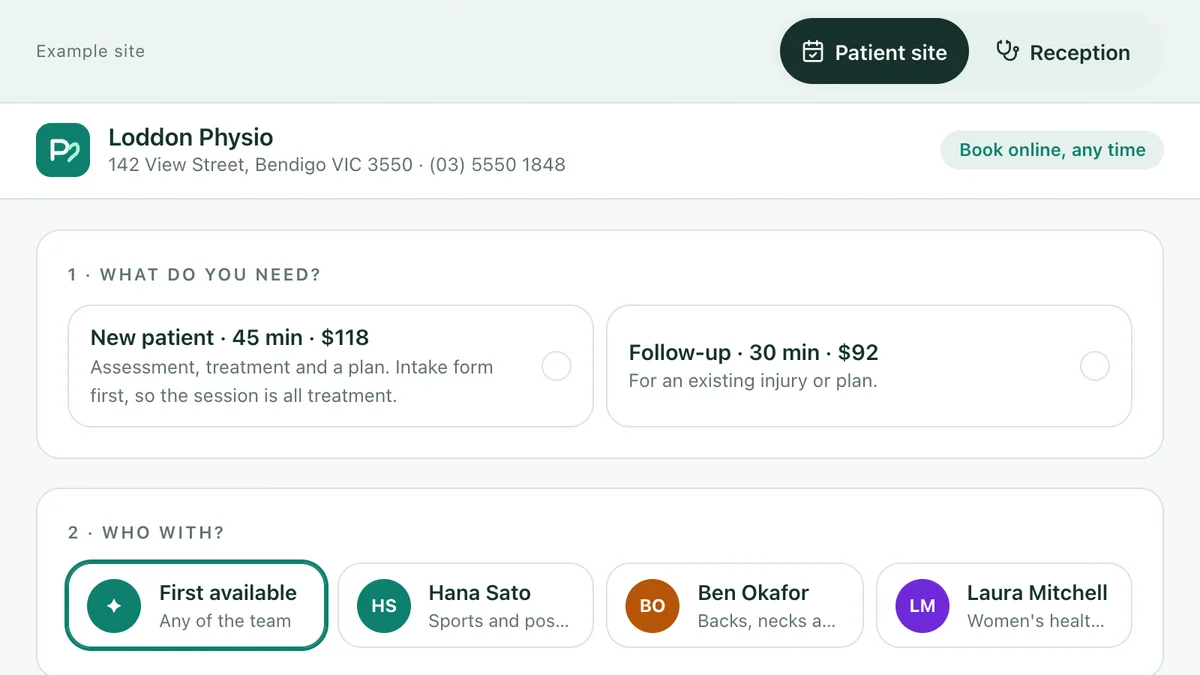
See it working
Software we'd build, running with a fictional business and sample data. Use it, then decide.
Also worth a look
- Patient Privacy for Australian Health Practices
- AI Scribes and AI Tools in Australian Practices
- Ahpra Advertising Rules for Practice Websites
- Online Booking for Clinics: Built-in, Marketplace or Custom
- Holding patient records? Security reviews for code, cloud and integrations
Last reviewed . General information, not legal, clinical or compliance advice. Prices are indicative Australian ranges, not quotes.