Advertising rules
What Ahpra's advertising rules mean for your website
Your clinic website is advertising under the National Law. So is the practice Facebook page, the Instagram account and every Google Ads campaign. A breach doesn't have to be deliberate. It can be a review widget someone switched on, a 'free assessment' with no conditions, or a bio that says 'specialist'. This guide covers what section 133 says, how it applies online, and how to audit your own site.
Rather just ask someone? Talk to usIn short
Section 133 of the National Law bans advertising a regulated health service in a way that misleads, uses testimonials, offers inducements without stated terms and conditions, creates an unreasonable expectation of benefit or encourages unnecessary use. It covers your website and business social media. Penalties reach $60,000 per offence for an individual and $120,000 for a body corporate.
General information about systems and processes, current as at November 2026. It isn't legal, clinical or compliance advice: check how the rules apply to your practice with your National Board, professional body, indemnity insurer or adviser.
- What counts as a testimonial?
- Ahpra treats a review as a testimonial when it says something positive about the clinical side of a service: the symptom or reason someone came in, the diagnosis or treatment, or the outcome, including the practitioner's skill. Testimonials can't be used in advertising. Comments about customer service or communication style aren't testimonials and can be used.
The penalties and dates that matter
From the National Law and Ahpra's published guidance, as at November 2026. Maximums are per offence.
- Breach of s 133, individual $60,000
- Raised from $5,000 in 2022. Applies in every state and territory, including WA since July 2024.
- Breach of s 133, body corporate $120,000
- Raised from $10,000 in 2022. A practice company can be the advertiser.
- Misusing a protected title, individual $60,000 and/or 3 years
- A separate offence from s 133. $120,000 for a body corporate.
- 'Surgeon' restricted for medical practitioners 3 November 2023
- Needs specialist registration in surgery, obstetrics and gynaecology, ophthalmology or another specialty with 'surgeon' in its title. 'Dental surgeon' and 'podiatric surgeon' are unaffected.
- General advertising guidelines in force 14 December 2020
- No replacement found in Ahpra's announcements through November 2026. The only new advertising guidelines since are the cosmetic ones.
- Non-surgical cosmetic guidelines 2 September 2025
- Apply to every registered profession, issued by all 15 National Boards.
- Professions in the National Scheme 16
- Regulated through 15 National Boards. Speech pathology, dietetics, exercise physiology, counselling and massage are outside it.
What actually works
Your website and your social pages are yours to keep clean
Whoever controls the website is responsible for any reviews it publishes or republishes. The same goes for the practice's business social media, such as the clinic Facebook page, even where the platform won't let you edit or remove reviews. Ahpra says you can comply by turning the review function off. If you want feedback on the site at all, use complete, unedited comments about service, like booking or reception. Trimming a mixed review to its good parts, or picking only the glowing ones, can itself be misleading.
Sites you don't control, and where Google reviews fit
Ahpra says you don't have to remove, or try to remove, reviews on websites or social media you don't control. On a third-party booking or review site that advertises health services, the site owner is responsible for the review function, and you're responsible for the content you control there, such as your profile. Ahpra's guidance never names Google; it lists 'a search engine' among the places reviews appear. Our reading, not Ahpra's words: patients' Google reviews aren't yours to remove, but embedding clinical ones on your site or in ads is using testimonials. Ahpra also warns that engaging with reviews on third-party sites may be considered using a testimonial.
Offers need their terms and conditions in the ad
A gift, discount or other inducement can only be advertised if the ad also states the terms and conditions, in plain language. Ahpra says people read 'free' as absolutely free, so an offer isn't free if the cost comes back through a price rise elsewhere or through Medicare. On a website, build the offer block so it can't be published without its conditions and an end date. Then nobody adds a 'free first consult' banner on a Friday afternoon.
No promises the treatment can't keep
Advertising can create an unreasonable expectation of benefit by calling a treatment 'safe', 'effective', 'risk-free' or 'pain-free' without acknowledging possible adverse reactions, or by showing unrealistic results. Urgency lines such as 'don't delay', 'act now before it's too late' or 'for a limited time only' may be unlawful when tied to unsupported claims that someone's health may suffer. Service pages work better describing what an appointment involves, who it suits and what the risks are.
Before-and-after images, and the cosmetic rules from 2 September 2025
For every profession, Ahpra says before-and-after photos are less likely to mislead when both shots match in angle, background, framing, lighting, posture, clothing and make-up, any alteration is explained, and the treatment is the only visible change. Edited or enhanced images may breach s 133. Since 2 September 2025, all registered professions advertising higher-risk non-surgical cosmetic procedures (dental veneers, injectables, thread lifts, hair transplants and others) must use real images with no misleading editing, and any ad that uses images needs a 'results may vary' warning. 'After' shots should say how long after the procedure they were taken, and an ad that names a practitioner must include their registration number. Influencer testimonials and ads aimed at under-18s are banned, and for these procedures liking or re-sharing a patient's post counts as using a testimonial.
Titles: 'specialist', 'Dr' and 'surgeon'
Each registered profession has protected titles, such as physiotherapist, podiatrist, psychologist and optometrist. Only medical practitioners, dental practitioners and podiatrists (as 'podiatric surgeon') have recognised specialties, and a practitioner without specialist registration should not say they are a 'specialist', 'specialise in' or are 'specialised'. That rules the words out for every other profession, and for doctors and dentists who don't hold specialist registration. Ahpra says 'substantial experience in' or 'working primarily in' is less likely to mislead. 'Dr' isn't protected, but non-medical practitioners should show their profession, as in 'Dr Lee (Osteopath)'. Since 3 November 2023 a medical practitioner can't use 'surgeon' without specialist registration in surgery, obstetrics and gynaecology, ophthalmology or another specialty with 'surgeon' in its title. Misusing a protected title is a separate offence: up to $60,000, three years' imprisonment, or both, for an individual.
You're the advertiser, even when an agency writes it
Ahpra treats whoever controls the advertising as the advertiser. That includes anyone who publishes or authorises content, or directs a staff member or marketing agency to draft or publish it, and it can be a practitioner, an unregistered person or a company. Advertisers must check content others produce for them. Ahpra and the National Boards can't approve ads or give legal advice; the guidelines point you to a lawyer or your indemnity insurer. So make it a rule that nothing goes live on the site or social pages until someone in the practice has approved it.
Audit your own website and social pages
Work through your website, Google Business Profile, practice social accounts and any ads. Anything you can't tick, fix, or take to your lawyer or indemnity insurer.
- No patient review on the site mentions a symptom, diagnosis, treatment or outcome, including in widgets that pull in Google reviews
- Review functions on the practice's Facebook page and other business social accounts are turned off, or hold no clinical testimonials
- Any feedback shown is complete and unedited, not trimmed or hand-picked
- Every offer, discount, gift or 'free' service states its terms and conditions in plain language in the same ad
- Nothing called 'free' is paid for through a higher fee elsewhere or through Medicare
- No 'safe', 'pain-free', 'risk-free' or 'effective' claims without the risks, and no 'act now' urgency tied to health claims
- Before-and-after photos match in angle, lighting, background and posture, any alteration is explained, and only the treatment's change shows
- Cosmetic procedure ads with images carry 'results may vary' and say how long after the 'after' photo was taken; ads that name a practitioner include the registration number
- Nobody is called a 'specialist', or said to 'specialise in' anything, without specialist registration
- Anyone called 'Dr' who isn't a medical practitioner has their profession beside their name
- Someone in the practice approves every page, post and ad that staff or an agency publish
Where we'd tell you otherwise
We build websites with these rules in mind and we'll flag anything we'd query as we go. We can't sign off your advertising as compliant, and neither can Ahpra: it says it can't approve advertising. For a judgement on specific wording, a cosmetic campaign or a title question, ask a lawyer or your indemnity insurer, as Ahpra's guidelines suggest.
Tell us how your practice runs
Describe the practice software you use and where time goes: phones, intake forms, re-typing, no-shows or the website. We'll tell you what we'd do first, including when the answer is a setting in software you already pay for.
jayson@pixelapps.com.au
1300 204 802
Macedon Ranges, Victoria
Serving clients across Australia
Common questions
Ahpra doesn't mention Google by name, so this is our reading of its testimonial guidance. Once you embed or republish reviews on your own site, you're responsible for them. Any that mention a symptom, treatment or outcome are testimonials and can't be used. Reviews purely about service, such as easy booking or friendly reception, can be, and Ahpra says publishing only complete, unedited reviews that aren't testimonials helps avoid a breach.
On our reading, no. Ahpra doesn't name Google, but it says practitioners don't have to remove, or try to remove, reviews on websites or social media they don't control, and that patients posting reviews is not what the rule targets. It does say to take care engaging with reviews on third-party sites, because that may be considered using a testimonial. Your own website and the practice's social pages are different: there, turn the review function off.
Section 133 is about advertising regulated health services, the kind usually provided by Ahpra-registered practitioners. Speech pathology, dietetics, exercise physiology, counselling and remedial massage or myotherapy aren't in the National Scheme, and audiology is the only profession Health Ministers have agreed to bring in. Check your professional body's standards. Our view: if your clinic also offers a registered service such as physiotherapy or psychology, write the whole site to the Ahpra rules.
You are. Ahpra's guidelines count anyone who directs a staff member or marketing agency to draft or publish content as an advertiser, and say advertisers must check content produced on their behalf. Businesses and unregistered people can be advertisers too. Neither Ahpra nor the National Boards can approve an ad in advance, so build an approval step into how content gets published.
Not in those words. Only medical practitioners, dental practitioners and podiatrists (as 'podiatric surgeon') have recognised specialties. Ahpra's own example flags a chiropractor described as 'a specialist in paediatric chiropractic care' and suggests 'has substantial experience working with musculoskeletal issues in children' instead. 'Working primarily in' is also less likely to mislead.
For a sole practitioner or small clinic, the Small Business Plan is $950 setup, then $95/month: up to 5 pages, hosting, security, small monthly updates and Google Business Profile upkeep. Larger sites, booking or intake integrations are custom work. Custom work is quoted individually, at a fixed price agreed before anything starts. Ongoing support for custom work is a retainer from $750 per month.
See it working
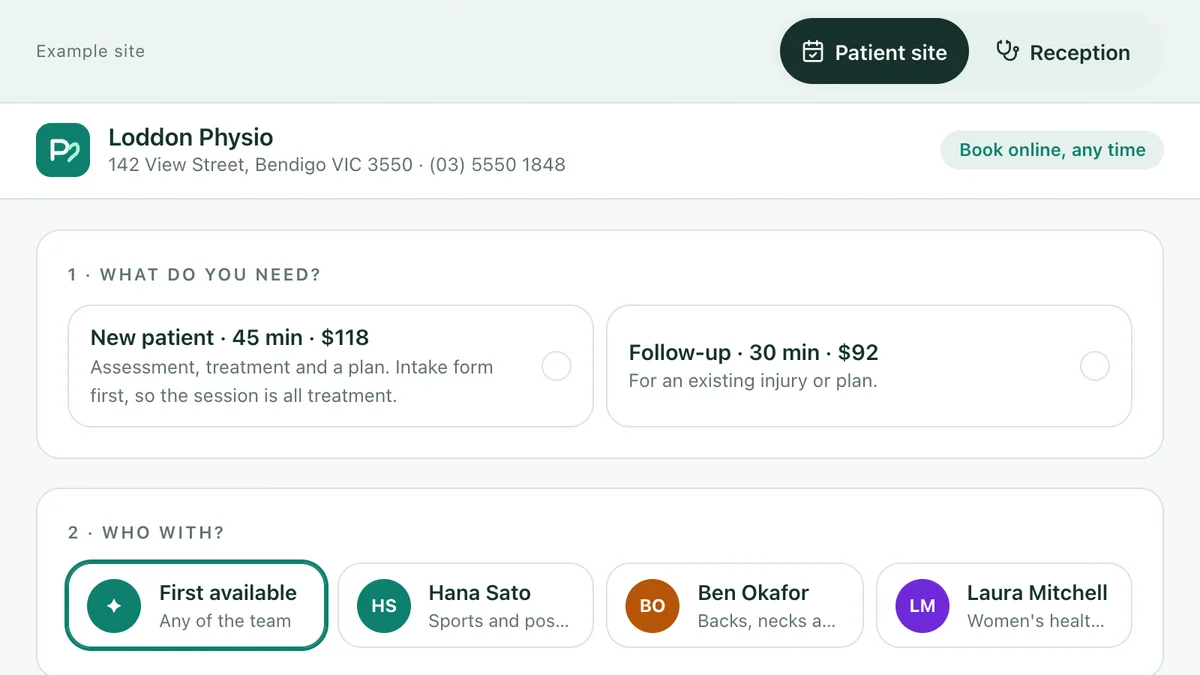
Software we'd build, running with a fictional business and sample data. Use it, then decide.
Also worth a look
- Websites for Health Practices in Australia
- Patient Privacy for Australian Health Practices
- Booking, Intake and Software for Physio Clinics
- Software and Websites for Dental Practices
- Holding patient records? Security reviews for code, cloud and integrations
Last reviewed . General information, not legal, clinical or compliance advice. Prices are indicative Australian ranges, not quotes.