Dentists
Recalls, treatment plans and websites around your dental software
A dental practice on Dental4Windows or Dental4Web from Centaur, Dentally, EXACT or OASiS from Henry Schein One, or Core Practice already has capable software. The gaps are around it: recalls nobody follows up, treatment plans patients can't remember by the time they get home, intake forms re-typed at the front desk, and a website that has to show results within Ahpra's advertising rules.
Rather just ask someone? Talk to usIn short
Dental4Windows, Dentally, EXACT, OASiS and Core Practice already hold the diary, charts and recall dates. What we build sits around them: recalls that get followed up, treatment plans patients can read and accept at home, intake that lands in the practice software where the vendor allows, and a website written with Ahpra's rules on before-and-after images and veneers in mind.
General information about systems and processes, current as at November 2026. It isn't legal, clinical or compliance advice: check how the rules apply to your practice with your National Board, professional body, indemnity insurer or adviser.
- What is a dental recall system?
- The way a practice tells patients their next check-up, clean or review is due, and follows up the ones who don't book. Your practice software already holds the recall dates. A recall system decides who gets which message, when, and what happens next if they don't respond.
Dental figures worth knowing
From Services Australia and Ahpra, current as at November 2026.
- CDBS benefit cap $1,158
- Per eligible child over two consecutive calendar years, for periods starting in 2026. Indexed each 1 January.
- CDBS age range 0–17
- For at least one day in the calendar year, Medicare-eligible, with a qualifying payment such as Family Tax Benefit Part A.
- Advertising penalty, individual $60,000
- Maximum per offence under s 133 of the National Law.
- Advertising penalty, body corporate $120,000
- Maximum per offence. The higher penalties have applied in every state, including WA, since July 2024.
- Cosmetic advertising guidelines 2 Sep 2025
- Veneers are named as a higher-risk non-surgical cosmetic procedure under these guidelines.
What actually works
Know your software's integration route first
Dental software comes in a few families. Centaur sells Dental4Windows (on-premise), Dental4Web (cloud) and Dental4Mobile. Henry Schein One sells Dentally, EXACT and OASiS. Core Practice is cloud software made in Australia. Each opens up differently: Core Practice runs a developer portal whose terms tie each integration to an approved purpose for your subscription tier, and Centaur runs a partner network. Find out what your vendor allows before anyone quotes a custom build.
Recalls that get followed up
The recall dates sit in your practice software; the work is chasing the patients who don't book. Two laws apply. Under the Privacy Act, the OAIC says consent can generally be implied for recalls and reminders about a patient's own care, while promotional messages to the whole database generally need express consent. Under the Spam Act, the ACMA says appointment reminders are generally not spam, but any promotional content makes a message commercial, and a promotional link can make it commercial too. So run two streams: plain recalls driven by your practice software, and a separate opt-in list for anything that sells.
Treatment plans patients can read at home
Ahpra's shared Code of conduct, which covers dental practitioners, asks for financial consent that addresses the costs of all required services, preferably before the service is provided. A secure page setting out each stage, its cost and what happens next, with an 'accept' step that records the date, backs up that conversation and lets the patient talk it over at home. Clinical consent stays with the dentist.
CDBS without the front-desk guesswork
The Child Dental Benefits Schedule covers Medicare-eligible children aged 0 to 17 for at least one day of the calendar year whose family receives a qualifying payment such as Family Tax Benefit Part A. Families don't apply; Services Australia sends them a letter. The cap is $1,158 per child over two calendar years for periods starting in 2026, indexed each 1 January. Ask about that letter in the child's intake form so eligibility is checked before the appointment, not at the counter.
Health fund claiming stays at the chair
On-the-spot claiming already runs through HICAPS or Tyro Health terminals connected to your practice software, and HICAPS lists Core Practice and Dentally among its integration partners. Don't rebuild it. What helps is the step before: an intake that collects the patient's fund and membership details properly, so the claim goes through first time and the gap conversation happens before treatment rather than after.
Titles, reviews and offers
Dentists are Ahpra-registered, so section 133 of the National Law covers your website and social media, with penalties of up to $60,000 per offence for an individual and $120,000 for a body corporate. Reviews that mention symptoms, treatment or outcomes count as testimonials and can't be used on your site or Facebook page. Only a dentist with specialist registration should be called a specialist; for everyone else, Ahpra says 'substantial experience in' is less likely to mislead. Any free or discounted offer must state its terms.
Before-and-after photos and veneers
Ahpra's general guidelines say before-and-after shots should match in angle, lighting, background and framing, with the treatment the only visible change and any alteration explained. Since 2 September 2025, veneers count as a higher-risk non-surgical cosmetic procedure. Ads for them must use real images without misleading editing, carry a warning that results may vary if they use images, should say how long after treatment each 'after' image was taken, and must include the registration number of any practitioner named. Ads aimed at under-18s are banned.
Before a smile gallery or review page goes live
A starting point for your own review, not compliance sign-off. Ahpra can't approve advertising and suggests advice from a legal adviser or indemnity insurer.
- Each before-and-after pair matches in angle, lighting, background and framing
- No image has been filtered, retouched or enhanced, or any alteration is explained
- Veneer images carry a 'results may vary' warning and say how long after treatment the 'after' shot was taken
- Veneer ads that name a dentist include their registration number
- No review describing symptoms, treatment or outcomes appears on the site or the practice's Facebook page
- Nobody without specialist registration is described as a specialist or as 'specialising in' anything
- Every free or discounted offer states its terms and conditions in plain language
Where we'd tell you otherwise
If your practice software's own recalls, online booking or patient forms already do the job, configure them fully before paying for anything custom; it's cheaper and one less system. HotDoc already integrates with Dental4Windows and Dental4Web. We're not a booking marketplace, we don't touch clinical decisions, and we don't give advertising compliance sign-off: that's for your legal adviser or indemnity insurer.
Tell us how your practice runs
Describe the practice software you use and where time goes: phones, intake forms, re-typing, no-shows or the website. We'll tell you what we'd do first, including when the answer is a setting in software you already pay for.
jayson@pixelapps.com.au
1300 204 802
Macedon Ranges, Victoria
Serving clients across Australia
Common questions
No. Those systems hold your appointments, charts, recall dates and billing. Recall follow-up, treatment plan delivery, intake forms and websites can be built alongside them and connected where the vendor allows. Core Practice publishes a developer portal; for other systems we check the vendor's partner program first.
Yes, with care. Ahpra's guidelines don't ban them, but they can mislead if the shots don't match or have been edited. For veneers and other higher-risk cosmetic procedures, the September 2025 guidelines require real images without misleading editing and a 'results may vary' warning. We can build the gallery so every image carries its caption and warning, but what goes in it is your call and your adviser's.
Only ones that aren't testimonials. Ahpra treats any review that mentions a symptom, treatment or outcome as a testimonial, which can't be used in advertising. Comments about customer service or communication may be used, but Ahpra says choosing which reviews to show can itself mislead, and that publishing only complete, unedited reviews that aren't testimonials helps avoid a breach. Ahpra's guidance doesn't name Google; our reading of it is that patients' Google reviews aren't yours to remove, but republishing clinical ones on your site would be using testimonials.
Then it's a commercial message under the Spam Act, so it needs the patient's consent, your contact details and a working unsubscribe. It's also advertising under s 133 of the National Law, so the offer has to state its terms and conditions. The ACMA's advice is to keep factual reminders and promotions separate. A plain recall is a separate question: under the Privacy Act the OAIC says consent for those can generally be implied, and the ACMA says appointment reminders are generally not spam.
Usually yes, and start with what your software already connects to. HotDoc integrates with Dental4Windows and Dental4Web through Centaur's Patient Discovery program, and HealthEngine is listed in Core Practice's app marketplace. A custom booking page makes sense when you need rules those tools can't express, such as new-patient visits that must collect a medical history before the slot is confirmed.
Custom work is quoted individually, at a fixed price agreed before anything starts. The price depends on your practice software and what needs connecting, and we set it after a short call. A practice of 1 to 5 staff can have its website on the Small Business Plan for $950 setup, then $95/month, with hosting, security, backups and small monthly updates included. Ongoing support for custom tools is a retainer from $750 per month.
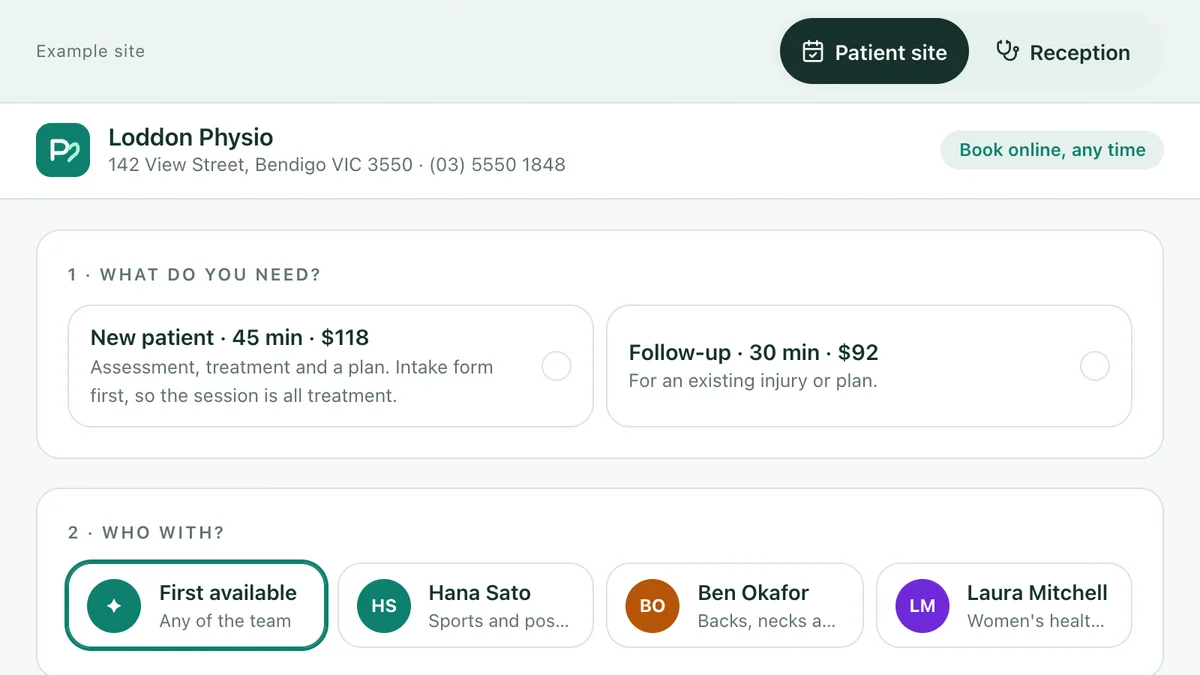
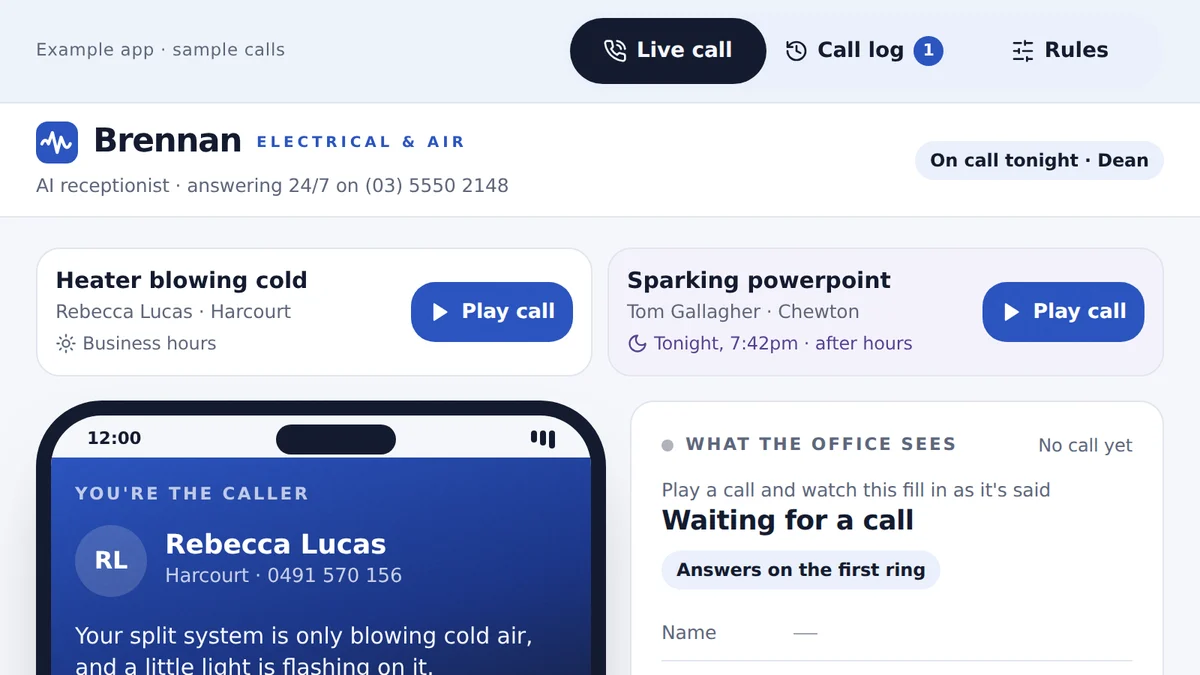
See it working
Software we'd build, running with a fictional business and sample data. Use it, then decide.
Also worth a look
- Ahpra Advertising Rules for Practice Websites
- Online Booking for Clinics: Built-in, Marketplace or Custom
- Patient Privacy for Australian Health Practices
- Websites for Health Practices in Australia
- Holding patient records? Security reviews for code, cloud and integrations
Last reviewed . General information, not legal, clinical or compliance advice. Prices are indicative Australian ranges, not quotes.