Physiotherapists
Physio clinic software that fills the gaps around your practice system
A physio clinic on Cliniko, Nookal, Halaxy, Coreplus, Splose or Zanda (formerly Power Diary) already has capable practice software. The gaps sit between the diary and the patient. People book the wrong appointment type. GP referral letters arrive by email and nobody counts the sessions left. Intake happens on a clipboard in the waiting room. Patients do two or three visits of a plan and drift.
Rather just ask someone? Talk to usIn short
Cliniko, Nookal, Halaxy and Coreplus already run a physio clinic's diary and notes and connect to claiming, so the work is around them: booking that knows an initial from a follow-up, intake that captures funding and screening answers before day one, referral and DVA cycle tracking, and rebooking prompts for patients part-way through a plan.
General information about systems and processes, current as at November 2026. It isn't legal, clinical or compliance advice: check how the rules apply to your practice with your National Board, professional body, indemnity insurer or adviser.
- What is a GP chronic condition management plan?
- The GP chronic condition management plan (GPCCMP) replaced GP Management Plans and Team Care Arrangements on 1 July 2025. A patient with a current plan and a GP referral letter can get up to 5 Medicare-subsidised allied health services a calendar year, including physiotherapy, or 10 for Aboriginal and Torres Strait Islander patients.
Physio numbers worth knowing
From the MBS, DVA, the NDIS Pricing Schedule 2026-27, the Department of Health, Disability and Ageing and Ahpra, as at November 2026. Check current figures before relying on them.
- MBS item 10960 (physiotherapy) $74.55
- Schedule fee from 1 July 2026, 85% benefit $63.40, at least 20 minutes
- Allied health services on a GPCCMP 5 a year
- Per calendar year (10 for Aboriginal and Torres Strait Islander patients), counted from 1 January
- Old GPMP/TCA plans valid until 30 June 2027
- After that the patient needs a GP chronic condition management plan or a multidisciplinary care plan
- DVA treatment cycle 12 sessions or 1 year
- Whichever ends first, then an end-of-cycle report to the usual GP
- NDIS physiotherapy price limit $183.99/hour
- 2026-27 national limit; remote +40%, very remote +50%
- NDIS claim window from 1 December 2026 90 days
- After the support is delivered, down from 2 years
- Maximum advertising penalty $60,000 / $120,000
- Per offence under s 133, individual / body corporate
What actually works
Make online booking know your appointment types
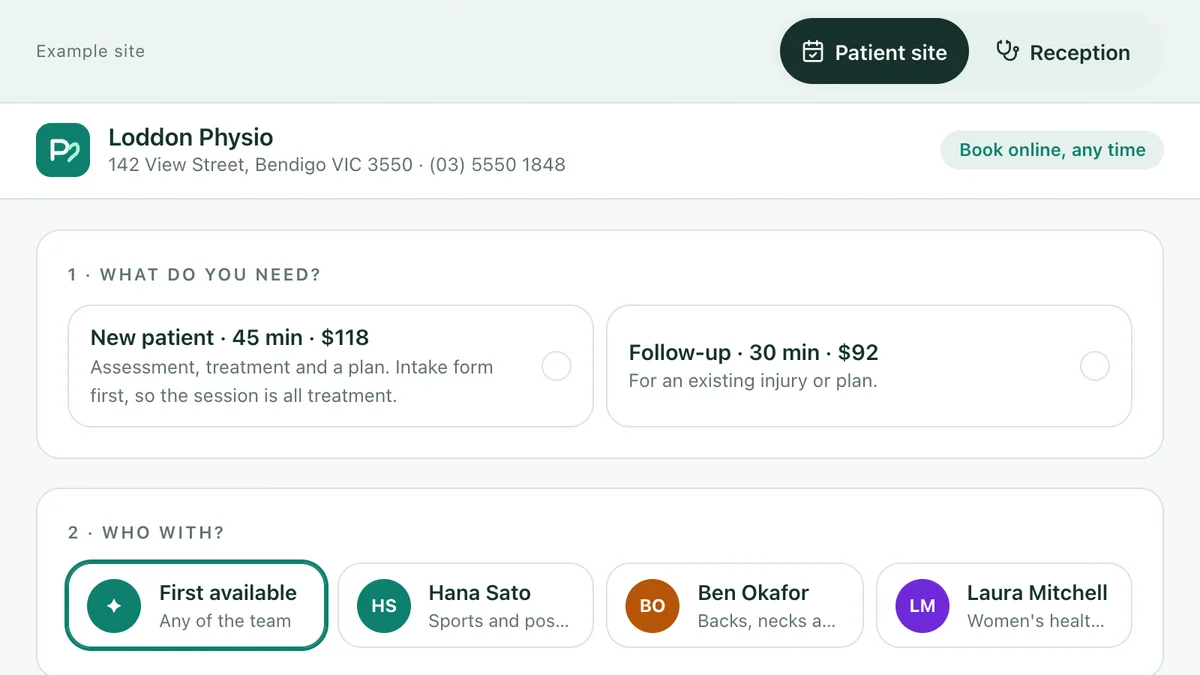
An initial assessment runs longer than a follow-up, and some clinics add separate types for funded or complex patients. Booking should offer a slot only when there's room for the type the patient picked, let them choose a physio or take the first available, and keep returning patients out of new-patient slots. Set up your practice software's own online booking properly first. Build custom only when your rules outgrow it.
Get intake done before the patient arrives
A structured intake asks the reason for the visit, history, medications and how the visit is funded once, on a phone, and writes the answers into the patient file where the vendor's API allows. Screening questions your physios agree on can flag answers for them to read before the session. The form flags; the physio decides. Under the Privacy Act everything you collect, appointment details included, is health information, so the form needs a collection notice and should ask only what you use.
Count GP referrals so nobody gets a surprise
Since 1 July 2025, referrals under GP chronic condition management plans are ordinary letters, not the old form. A patient gets up to 5 MBS allied health services a calendar year in total, so ask whether they've used any elsewhere, and the plan must have been prepared or reviewed in the last 18 months. Capture the letter and plan date at intake, count services as they're used, and prompt the written report the GP needs after the first and last service.
Track DVA treatment cycles
A DVA referral covers up to 12 sessions or one year, whichever ends first. At the end of the cycle you send a report to the veteran's usual GP, who can write a new referral. TPI Gold Card holders are exempt for physiotherapy. Intake should record the card type (Veteran Card – All Conditions or Veteran Card – Specific Conditions), the accepted conditions for Specific Conditions holders, and where the patient is up to in the cycle.
Leave claiming in the practice software
HICAPS takes private health fund claims from practice software to its Trinity terminal, and sends government scheme claims (Medicare, NDIS, DVA, WorkSafe Victoria, TAC, WorkCover Queensland, icare) through HICAPS Digital, with results reconciled back. Its listed partners include Halaxy and Nookal. Cliniko connects to Tyro Health for Medicare, DVA and health fund claims. A custom build should feed those systems clean data, not try to claim around them.
Prompt rebooking between visits
Prompt the next booking before the patient leaves, remind them of booked visits, and flag anyone with sessions left on a referral who hasn't rebooked. Home exercise programs belong in a tool like Physitrack, which lists integrations with Cliniko, Coreplus, Halaxy and BpAllied. Keep reminders factual: the ACMA says appointment reminders are generally not spam, but promotional content in the same message makes it commercial.
Your website is advertising, under rules with real penalties
'Physiotherapist' and 'physical therapist' are protected titles. Physiotherapy has no recognised specialty, so don't advertise anyone as a 'specialist'; Ahpra says 'substantial experience in' is less likely to mislead. Testimonials about clinical results are banned on your own site and your clinic's Facebook page, where Ahpra says turning off reviews is one way to comply. Breaches of s 133 carry up to $60,000 per offence for an individual and $120,000 for a body corporate.
What a physio intake should capture before the first visit
Ask these once, online, and write the answers straight into the patient file.
- Reason for the visit, in the patient's own words, and how long it's been going on
- How the visit is funded: private, health fund, GP chronic condition plan referral, DVA, NDIS, or a workers' compensation or transport accident claim
- For GP referrals: the referral letter, the plan date and MBS allied health services already used this year
- For DVA: card type, accepted conditions for Specific Conditions holders, and the referral date
- For NDIS: whether the plan is NDIA-managed, plan-managed or self-managed
- The screening questions your physios have agreed on, with flagged answers shown before the session
- A collection notice, consent to collect, and how they'd like reminders sent
Where we'd tell you otherwise
If your practice software's own online booking, intake forms and reminders already do what you need, configure them fully before paying for anything custom; it's cheaper and one less system. We're not a booking marketplace and we don't build clinical decision tools. We also can't sign off your advertising: Ahpra says to get that advice from a lawyer or your indemnity insurer.
Tell us how your practice runs
Describe the practice software you use and where time goes: phones, intake forms, re-typing, no-shows or the website. We'll tell you what we'd do first, including when the answer is a setting in software you already pay for.
jayson@pixelapps.com.au
1300 204 802
Macedon Ranges, Victoria
Serving clients across Australia
Common questions
No. We build around the system you run and connect through the vendor's API where it allows. Cliniko and Nookal publish APIs with permission-limited keys, Halaxy's FHIR API is a paid subscription, and Coreplus reviews add-ons before production use. Zanda's API is still in closed beta, and Jane has no open API and says it has no plans for one, which limits what anyone can build on those two.
Yes. The booking flow asks whether they're new or returning and what the visit is for, then offers only slots long enough for that appointment type, with a named physio or the first available. Try the working demo linked above. If your practice software has online booking of its own, check how far its settings go before building anything.
It can ask the questions your physios choose and flag answers for them to read before the session. It shouldn't make the call. The TGA's digital scribe guidance says tools that suggest diagnoses or treatments are likely medical devices, and we don't build those.
GP chronic condition management plans replaced GP Management Plans and Team Care Arrangements on 1 July 2025. Referrals are now standard letters. Patients get up to 5 MBS allied health services a calendar year, the plan must have been prepared or reviewed in the last 18 months, and plans made before 1 July 2025 remain usable until 30 June 2027.
Reminders for booked visits generally don't need separate consent: the OAIC says it can be implied. Announcements are different: the OAIC gives announcing a new physiotherapist as an example of a message to the whole database that generally needs express consent, and under the Spam Act any promotional content makes a message commercial. Also register your SMS sender ID; since 1 July 2026 unregistered branded texts show as 'Unverified'.
It depends on your appointment types, funding streams and the integration your practice software allows, so we quote after a short call. Custom work is quoted individually, at a fixed price agreed before anything starts. A sole or small practice website on the Small Business Plan is $950 setup, then $95/month; ongoing support for custom work is a retainer from $750 per month.
See it working
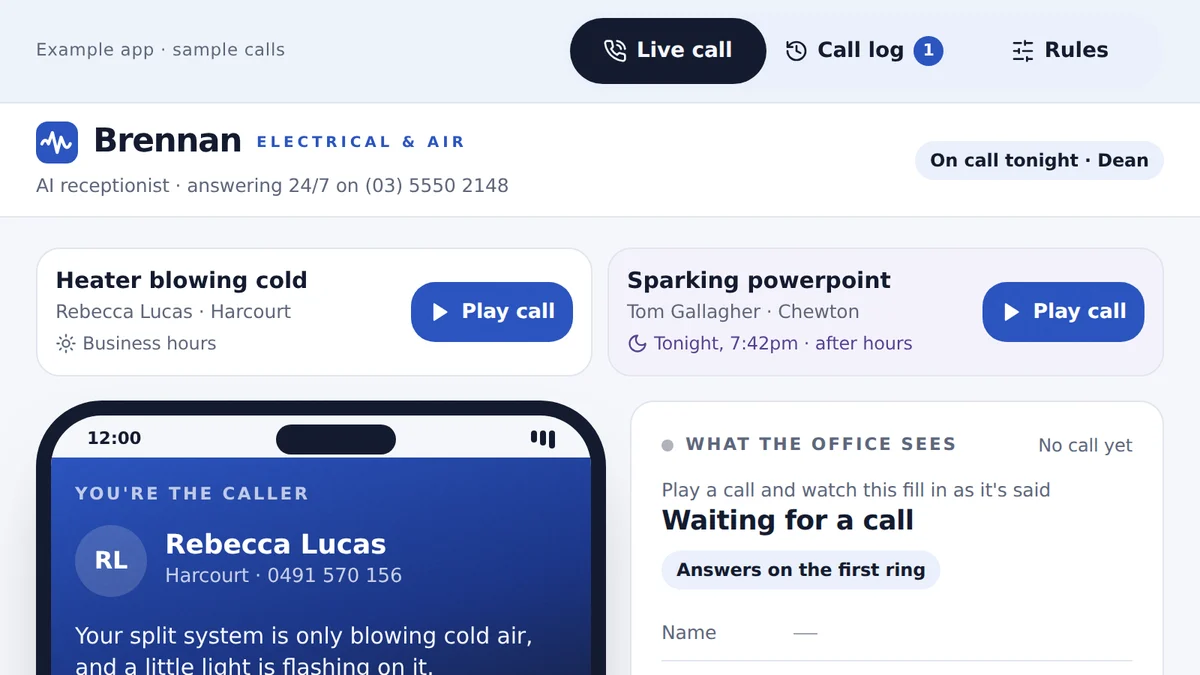
Software we'd build, running with a fictional business and sample data. Use it, then decide.
Also worth a look
- Online Booking for Clinics: Built-in, Marketplace or Custom
- Ahpra Advertising Rules for Practice Websites
- Patient Privacy for Australian Health Practices
- Software for Exercise Physiology Practices
- Holding patient records? Security reviews for code, cloud and integrations
Last reviewed . General information, not legal, clinical or compliance advice. Prices are indicative Australian ranges, not quotes.