Practice websites
A practice website that answers patients, written with the advertising rules in mind
A patient deciding whether to book wants to know a handful of things. Do you treat this? Who will I see? What will it cost, and can I claim? Where are you, and when can I come in? A practice website should answer each one plainly and link straight to booking. It should also stay clear of what the advertising rules for regulated health services prohibit, starting with testimonials. Many sole practitioners and small clinics need only a small site kept up to date. Larger practices sometimes need more.
Rather just ask someone? Talk to usIn short
A health practice website should say what you treat, who treats it, what it costs, how rebates and claiming work, where you are and when you're open, and link straight to booking, in plain words patients and AI assistants can quote. For Ahpra-registered professions it must also avoid clinical testimonials, unregistered 'specialist' claims and offers without terms and conditions.
General information about systems and processes, current as at November 2026. It isn't legal, clinical or compliance advice: check how the rules apply to your practice with your National Board, professional body, indemnity insurer or adviser.
What actually works
Answer the questions patients ask
Services described by the problems you treat and the treatments you offer, in plain language. A page per practitioner. Fees. Rebates and claiming. Location, parking, access and hours. A booking button on every page that goes to the right appointment type in your practice software's booking, not a generic contact form. If a patient has to ring to find out whether you treat their problem, the site has missed its job.
Publish fees and explain claiming
Ahpra's shared Code of conduct covers 12 professions, including physiotherapists, chiropractors, osteopaths, podiatrists, OTs, optometrists, dental practitioners and pharmacists (doctors, nurses and psychologists have their own codes). It asks practitioners to discuss fees before the service where possible. A fees page doesn't replace that conversation, but it shortens it. Say whether you claim private health on the spot (HICAPS says it handles on-the-spot claims for all Australian private health funds), whether you see patients on GP chronic condition management or DVA referrals, and what your cancellation policy is.
Practitioner profiles: titles matter
Each registered profession has protected titles. Only medical practitioners, dental practitioners and podiatric surgeons can hold specialist registration, so a physio or chiro profile shouldn't say 'specialist', 'specialises in' or 'specialised'. Ahpra says 'substantial experience in' or 'working primarily in' is less likely to mislead. If a non-medical practitioner uses 'Dr', name the profession alongside it, as in Ahpra's own example: 'Dr Lee (Osteopath)'.
No clinical testimonials on anything you control
Section 133 of the National Law bans testimonials in advertising a regulated health service. A review counts as a testimonial if it mentions a symptom, diagnosis, treatment or outcome; comments about customer service or communication don't. Whoever controls the website is responsible for reviews it publishes, and a clinic's Facebook page counts as advertising, so turn its reviews off. Ahpra doesn't name Google, but on our reading of its guidance, patients' Google reviews aren't yours to remove, while embedding clinical ones on your site would be using them. The maximum penalty is $60,000 per offence for an individual and $120,000 for a body corporate.
Offers, claims and images
A 'free' or discounted offer must state its terms and conditions, and Ahpra says an offer isn't free if the cost is recovered through a price rise elsewhere or through Medicare. Words such as 'safe', 'pain-free' or 'risk-free' without the risks can create unreasonable expectations. Urgency lines such as 'don't delay' may be unlawful when tied to unsupported claims that someone's health may suffer. Ahpra says before-and-after images are less likely to mislead when the shots match and the treatment is the only visible change. The practice remains the advertiser even when an agency writes the copy, which includes copy we write.
Accessibility and privacy are part of the build
The Australian Human Rights Commission's 2025 guidelines say organisations should meet WCAG 2.2 Level AA at a minimum, and they use seeking medical services as an example. The Privacy Act covers every health service provider whatever its turnover, so the site needs a privacy policy that covers what APP 1 requires. Keep advertising pixels off booking and intake pages, label any chatbot as AI, and from 10 December 2026 say in the policy if a computer program makes or substantially informs significant decisions about people.
Be easy for Google and AI assistants to quote
Some patients now ask an AI assistant, not just Google, which clinic nearby treats their problem, takes their health fund or sees DVA clients. An assistant can only repeat what a page says plainly. Write the facts as sentences as well as headings: what you treat, the suburbs you serve, hours, fees and claiming. Keep your Google Business Profile's hours, categories and services matched to the site.
The Small Business Plan or a custom build
Many sole and small practices need only the first. The second is for practices whose website is also part of intake, booking or claiming.
| Criteria | The Small Business Plan | Custom build |
|---|---|---|
| Suits | Practices with 1 to 5 staff | Multi-practitioner or multi-location practices with intake, portal or integration needs |
| Pages | Up to 5 | As many as the practice needs |
| Booking | Links to your practice software's online booking | A custom booking front end through your software's API, where the vendor allows |
| Upkeep | Hosting, security, backups, small monthly updates, local SEO and Google Business Profile upkeep included | A support retainer from $750 per month |
| Price | $950 setup, then $95/month | Fixed price, quoted upfront before any work starts. |
Before your practice site goes live
Work through these with whoever signs off your advertising. Most come from Ahpra, OAIC and Human Rights Commission guidance; the last two fee and profile checks are ours.
- No clinical testimonials on the site, the clinic's social pages or ads, and reviews switched off on the clinic's Facebook page
- Any reviews you show are complete, unedited and about service, not clinical results
- No 'specialist' or 'specialises in' unless the practitioner holds specialist registration
- Every 'Dr' who isn't a medical practitioner has their profession beside the name
- Every offer states its terms and conditions in plain language
- Fees, claiming options and the cancellation policy are published
- The privacy policy covers what APP 1 requires, including any tracking pixels and AI tools
- Booking and contact forms tested against WCAG 2.2 Level AA
- Google Business Profile hours, address and services match the site
Where we'd tell you otherwise
If your practice software's booking page and an accurate Google Business Profile already bring you the patients you need, a website may not be your first job; get the profile right first. We also don't give advertising compliance sign-off. Ahpra and the National Boards can't approve advertising either, and they point advertisers to a legal adviser or indemnity insurer. We write and build with the published guidelines in front of us and flag anything we'd query, but the practice is the advertiser and the final call is yours.
Tell us how your practice runs
Describe the practice software you use and where time goes: phones, intake forms, re-typing, no-shows or the website. We'll tell you what we'd do first, including when the answer is a setting in software you already pay for.
jayson@pixelapps.com.au
1300 204 802
Macedon Ranges, Victoria
Serving clients across Australia
Common questions
The Small Business Plan is $950 setup, then $95/month, for businesses of 1–5 staff. It covers a site of up to 5 pages, hosting, security, backups, small monthly updates, local SEO and Google Business Profile upkeep. Larger sites, booking front ends, intake and integrations are custom work. Custom work is quoted individually, at a fixed price agreed before anything starts. Ongoing support for custom work is a retainer from $750 per month.
Not clinical ones, if you're a registered profession. Ahpra's guidance doesn't name Google, but it says the testimonial ban applies when an advertiser uses reviews to promote the service. Our reading is that patients' reviews on Google aren't yours to remove, while embedding reviews that mention symptoms, treatment or outcomes on your site would be using testimonials. Comments about service and communication may be used, published complete and unedited.
We write and build with the published guidelines in mind and point out anything we'd query, but we can't sign it off and neither can Ahpra: it doesn't approve advertising. The guidelines tell advertisers to get independent advice from a legal adviser or indemnity insurer. The practice stays the advertiser, including for copy an agency writes.
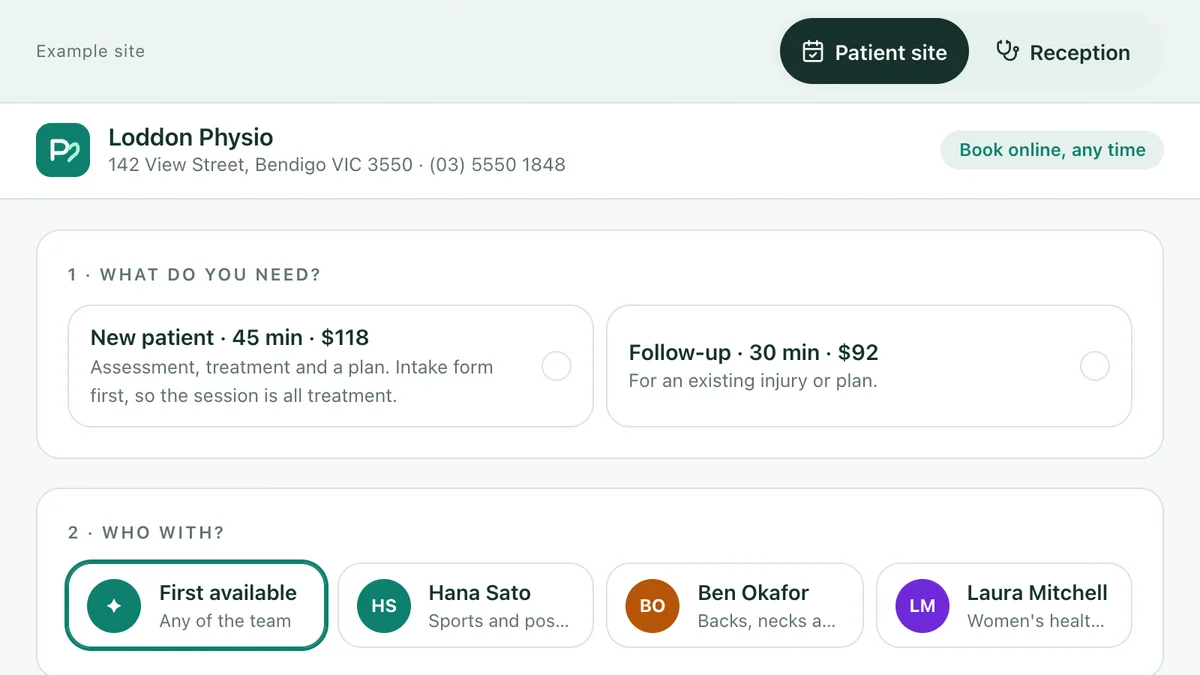
Yes, through the online booking your practice software provides, if it has one. Where its booking page supports it, we link each service to the right appointment type. If you need routing, referral capture or a health history before the first visit, that's a custom booking front end, which depends on what your software's API allows.
Yes. The Privacy Act covers every health service provider whatever its turnover, and APP 1 requires a clearly expressed, up-to-date privacy policy covering what you collect, why, how people can access and correct it, how to complain, and any overseas disclosure. From 10 December 2026 it must also say if a computer program makes or substantially informs significant decisions about people.
Nobody can promise that. What helps is a site that states your services, suburbs, hours, fees and claiming options as plain sentences, with structured data behind them, and a Google Business Profile that says the same things. That's how we'd build yours.
See it working
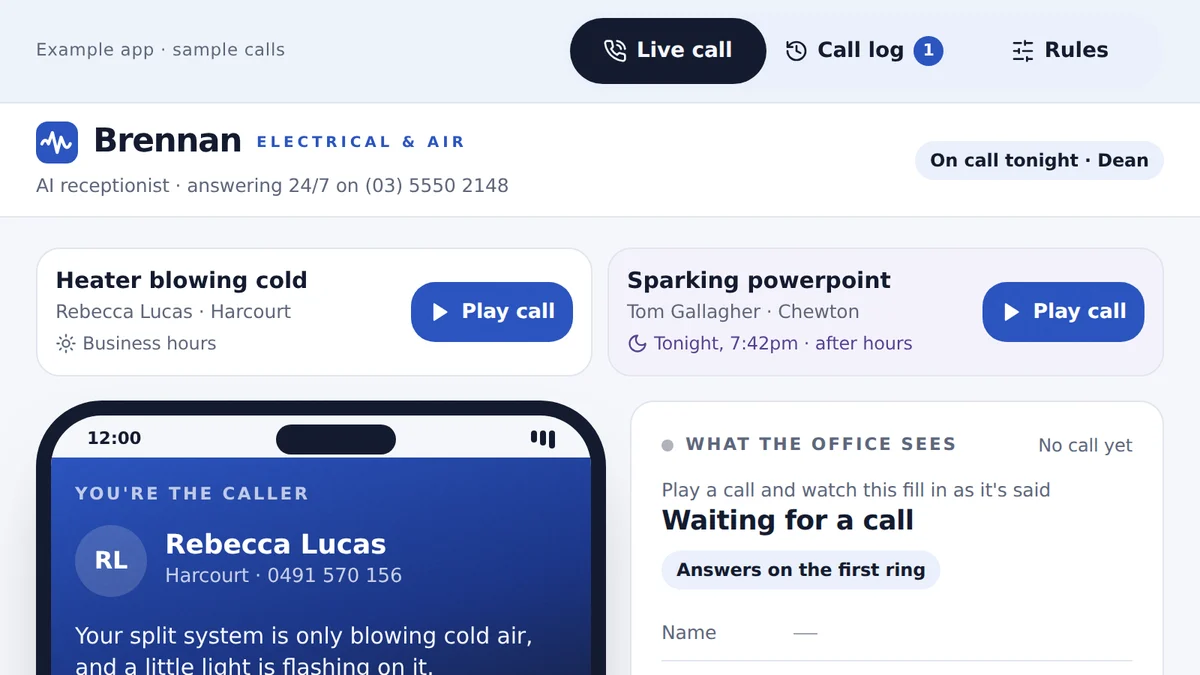
Software we'd build, running with a fictional business and sample data. Use it, then decide.
Also worth a look
- Ahpra Advertising Rules for Practice Websites
- Online Booking for Clinics: Built-in, Marketplace or Custom
- Patient Privacy for Australian Health Practices
- Booking, Intake and Software for Physio Clinics
- Holding patient records? Security reviews for code, cloud and integrations
Last reviewed . General information, not legal, clinical or compliance advice. Prices are indicative Australian ranges, not quotes.