Remedial massage & myotherapy
Systems for massage and myotherapy clinics: booking, claiming, intake and vouchers
A remedial massage or myotherapy clinic depends on regular clients: a booking that fits their week, a health fund claim at the desk, a health history that's current, and the next appointment booked before they leave. Gift vouchers can bring in new ones. None of this needs exotic software. It needs your practice system set up properly, a few gaps filled, and a clear view of which rules apply to a profession that isn't Ahpra-registered.
Rather just ask someone? Talk to usIn short
Remedial massage therapists and myotherapists aren't Ahpra-registered, but they're still health service providers under the Privacy Act, and their association says the sector is covered by the National Code of Conduct for Health Care Workers. The useful setup is practice software connected to HICAPS for on-the-spot health fund claims, online booking that asks about claiming, a structured health history, gift vouchers that reconcile, and rebooking at checkout.
General information about systems and processes, current as at November 2026. It isn't legal, clinical or compliance advice: check how the rules apply to your practice with your National Board, professional body, indemnity insurer or adviser.
What actually works
Know which rules apply to you
Remedial massage and myotherapy aren't among the 16 professions Ahpra registers. Massage & Myotherapy Australia says its members meet probity standards similar to Ahpra's core registration standards, and that the sector is covered by the National Code of Conduct for Health Care Workers and state health complaints bodies. Section 133 of the National Law, with its testimonial ban, covers advertising of a 'regulated health service', which the law defines as a service provided by, or usually provided by, a health practitioner. Ahpra's guidance doesn't say how that applies to a clinic that offers only massage or myotherapy, so ask your association or adviser rather than assume. Two things are clear: if the business also provides a registered service such as physiotherapy, advertising the business is covered; and titles such as 'physiotherapist' and 'physical therapist' are protected.
You're a health service provider under the Privacy Act
The OAIC's list of health service providers names massage therapists, and the Privacy Act covers every health service provider whatever its turnover, so the small business exemption doesn't apply. Everything collected while providing the service is health information, including names and appointment and billing details. That means consent to collect a health history, a collection notice on the intake form, reasonable security and a privacy policy on your website. Health histories emailed as PDFs and left in a shared inbox are the first thing to fix.
Health fund claiming at the desk, without keying it twice
HICAPS says it handles on-the-spot claims for all Australian private health funds. Connected to your practice software through its Trinity Terminal integration, the claim goes from the invoice to the terminal and the result comes back to the software. HICAPS lists Nookal and Halaxy among its integration partners and doesn't charge for the integration. Cliniko connects to Tyro Health, which processes health fund claims.
Booking that asks about claiming up front
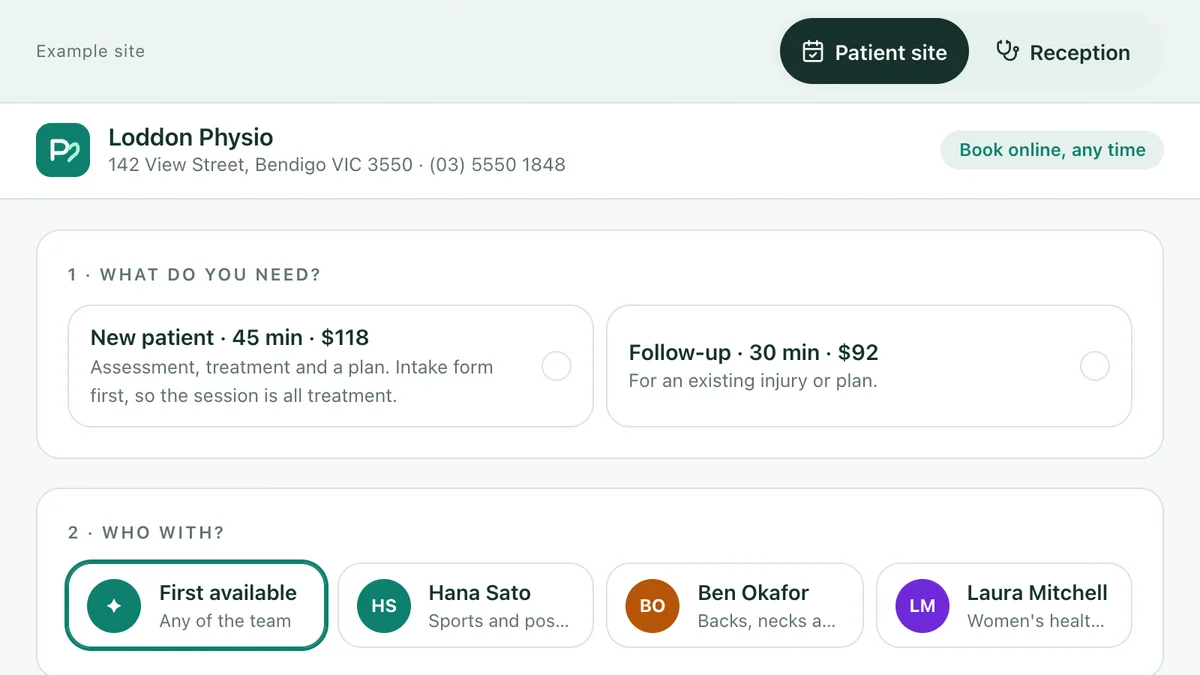
Online booking should ask early whether the client plans to claim on private health, so reception knows before they arrive and the reminder can explain how claiming works at your clinic. Collect what the claim needs and nothing more. The OAIC's advice is to collect only what's reasonably necessary, and as the Privacy Commissioner put it, 'Organisations can't lose personal information they don't hold.' Let clients choose a therapist or first available, and size slots by treatment length so the diary doesn't fill with unusable gaps.
A health history the therapist reads
A new client's health history should arrive before the first appointment, in a structured form a therapist can scan in a minute. What it asks is for you, your association and your insurer to decide. The form can mark the answers you've chosen to be flagged, file itself in the client's record in your practice software where the vendor allows, and ask returning clients to confirm or update it rather than start again.
Gift vouchers need a register, not a spreadsheet
Sell vouchers on your website with online payment, issue each one a unique code by email, and print the terms on it: what it covers and when it expires. Record every voucher so reception can redeem it against an invoice and see what's still outstanding. If your practice software tracks vouchers, use that; if it doesn't, a small voucher register linked to the online shop does the job.
Rebooking and reminders that stay factual
Book the next appointment before the client leaves and let the reminder follow automatically. Keep reminders factual. The ACMA says appointment reminders are generally not spam, but add a promotion such as a discount on the next massage, or a link to one, and the message can become commercial, which needs consent and a working unsubscribe. The OAIC says offers sent to your whole client list generally need express consent. Since 1 July 2026, texts from an unregistered branded sender ID show 'Unverified', so register yours through your SMS provider.
A massage or myotherapy clinic's systems, checked
If more than two of these aren't true yet, start with those before buying anything new.
- Your practice software is connected to your HICAPS terminal or claiming service, so claims aren't keyed twice
- Online booking asks whether the client wants to claim on private health
- New clients complete a health history online before the first visit, and it lands in their record, not an inbox
- The intake form carries a collection notice and links to your privacy policy
- Your website makes no claims you couldn't back up, and no one is called a physiotherapist who isn't one
- Reminder texts carry no offers; promotions go separately to clients who agreed to receive them
- Your SMS sender ID is registered, so reminders don't arrive as 'Unverified'
- Every gift voucher has a unique code, printed terms and a balance reception can see
Where we'd tell you otherwise
If your practice software's own booking, intake forms and HICAPS connection already do the job, set them up fully and stop there. We don't sell practice software, claiming terminals or health fund provider registration, and we don't advise on what your association or the health funds require of you. We build the website, booking, intake and vouchers around the system you choose.
Tell us how your practice runs
Describe the practice software you use and where time goes: phones, intake forms, re-typing, no-shows or the website. We'll tell you what we'd do first, including when the answer is a setting in software you already pay for.
jayson@pixelapps.com.au
1300 204 802
Macedon Ranges, Victoria
Serving clients across Australia
Common questions
Section 133 covers advertising of a regulated health service, meaning a service provided by, or usually provided by, a health practitioner. Massage and myotherapy aren't Ahpra-registered professions, and Ahpra's guidance doesn't say how the section applies to a clinic offering only those services, so that's a question for your association or adviser. If your business also offers a registered service, such as physiotherapy or chiropractic, advertising the business is covered. Protected titles such as 'physiotherapist' are off limits either way.
That depends on whether section 133's testimonial ban applies to your clinic, which is a question for your association or adviser, not us. It does apply to the advertising of a business that also provides a registered service such as physiotherapy. If you're unsure, the cautious approach is the one Ahpra allows registered professions: complete, unedited comments about service and communication, not about symptoms, treatment or results.
We don't sell one. Cliniko, Nookal and Halaxy are allied health practice systems. For health fund claiming, HICAPS lists Nookal and Halaxy among its integration partners, and Cliniko connects to Tyro Health. Halaxy says its core software is free and that it charges only for add-ons such as payments, rebates and SMS. Jane offers an Australian data centre, but has no open API and says it has no plans for one, which limits what can be built around it.
Yes. We build a voucher page that takes payment, emails a unique code with the terms printed on it, and records the voucher so reception can redeem it against an invoice. Whether redemption happens inside your practice software depends on what it supports; if it can't, we build a simple voucher register that reception checks.
Yes. The OAIC names massage therapists among health service providers, and the Privacy Act covers every health service provider whatever its turnover. A client's name, appointments and billing details count as health information, not just their health history. You need a privacy policy, a collection notice on intake forms and reasonable security over all of it.
A clinic website on the Small Business Plan is $950 setup, then $95/month. Online booking, intake and vouchers built around your practice software depend on what it allows, so we quote after a short call. Custom work is quoted individually, at a fixed price agreed before anything starts. Ongoing support for custom work is a retainer from $750 per month.
See it working
Software we'd build, running with a fictional business and sample data. Use it, then decide.
Also worth a look
- Websites for Health Practices in Australia
- Online Booking for Clinics: Built-in, Marketplace or Custom
- Patient Privacy for Australian Health Practices
- Ahpra Advertising Rules for Practice Websites
- Holding patient records? Security reviews for code, cloud and integrations
Last reviewed . General information, not legal, clinical or compliance advice. Prices are indicative Australian ranges, not quotes.