Optometrists
Eye test booking, recall follow-up and order messages for optometry practices
Many Australian optometry practices run one of two local systems: Optomate from Melbourne's Monkey Software, which calls itself the region's most widely used, or Vision Elite from Sunix. Both are practice management systems built for optometry. The gaps are around them: recalls that go out but aren't followed up, booking that can't tell a contact lens fitting from a full exam, and staff answering calls about orders.
Rather just ask someone? Talk to usIn short
Optomate and Sunix stay at the centre of an optometry practice. Around them, a practice can add booking that knows a contact lens fitting from a full eye exam, recalls that follow up patients who don't book, 'your glasses are ready' messages driven by order status, and a website written with Ahpra's rules on free offers and titles in mind.
General information about systems and processes, current as at November 2026. It isn't legal, clinical or compliance advice: check how the rules apply to your practice with your National Board, professional body, indemnity insurer or adviser.
- What is the Optomate Touch API?
- A RESTful service that runs on a practice's own Optomate server. Monkey Software says any third-party product that needs to read or write the Optomate Touch database must go through it, and the practice chooses which data to expose. Monkey Software installs it for supported customers at no extra cost.
What actually works
Two local systems, two different paths
Optomate comes from Monkey Software in Melbourne, part of the Neox-IT group, as Optomate.Net in the cloud and Optomate Touch on your own server. Sunix sells Vision Elite, installed on site, and has been releasing a cloud-only Vision NEXT Generation in modules since early 2022, by Sunix's account. Optomate Touch Release 4.1, out 12 November 2026, is fully 64-bit and no longer supports 32-bit Windows, so check older front-desk PCs before you upgrade.
Integrate through the supported door
Optomate Touch has a documented API that runs on your Optomate server, and third parties must use it for database access. That gives a custom tool a supported route, limited to the data you choose to expose. Sunix lists Medicare, HICAPS and business integrations; we found no published API documentation, so for a Sunix practice we ask Sunix what's possible before quoting anything that needs to read or write your records.
Booking that knows the appointment type
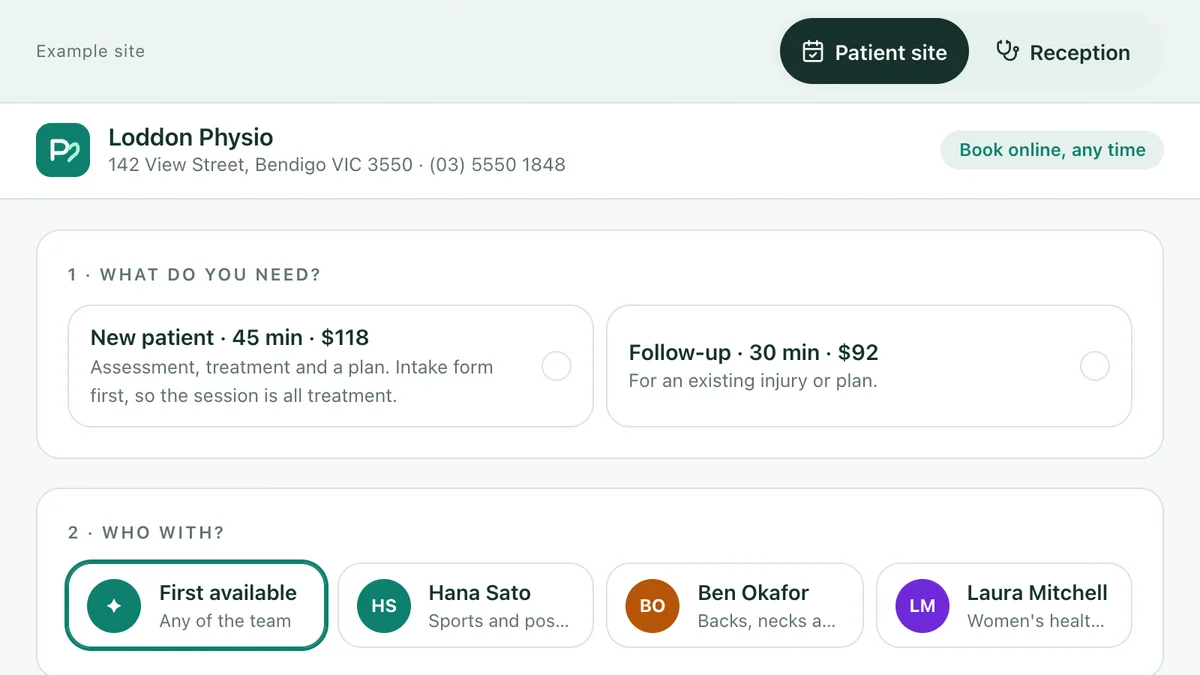
A comprehensive eye exam, a contact lens fitting and a frame adjustment need different lengths and sometimes different staff and equipment. Ask what already connects: HotDoc's demo form lists Optomate Touch and Sunix among the optometry systems it works with, so confirm with HotDoc what that covers for yours. Where those tools can't express your rules, a booking page that offers only valid slots for each appointment type helps avoid double-booked equipment and overruns.
Recalls, kept clinical
Recall dates live in your practice software. Under the Privacy Act, the OAIC says consent can generally be implied for recalls and reminders about a patient's own care, while promotional messages sent to the whole database generally need express consent. A recall that also plugs the new frame range becomes commercial under the Spam Act and needs consent and an unsubscribe. Keep the recall plain, follow up the patients who don't book, and run promotions on a separate opt-in list.
Order updates without the phone calls
Calls asking whether glasses or contact lenses have arrived are routine and repetitive. A factual 'your glasses are ready to collect' message, triggered by the order status in your practice software where the vendor's API allows, answers the question before it's asked. The ACMA says messages about a service a person uses are generally not spam. A prompt to reorder lenses is different: it offers a product, so treat it as a commercial message.
Free offers and titles in your advertising
Optometrists are Ahpra-registered, and 'optometrist' and 'optician' are protected titles. Section 133 of the National Law requires any gift or discount offer to state its terms, and Ahpra says 'free' must mean absolutely free: an eye test whose cost is recovered through Medicare or a price rise elsewhere isn't free. An optometrist who uses 'Dr' should make their profession clear. Ahpra's example is 'Dr Lee (Osteopath)'; for you that's 'Dr [Name] (Optometrist)'. Clinical testimonials can't be used on your site or Facebook page.
Medicare and fees stay in your software
Medicare claiming runs through web services in your practice software, authenticated through PRODA, and Sunix lists Medicare integration among its features. Two rules shape any booking or payment page you add. If you bulk bill a service you can't add charges to it, such as a booking fee. And Medicare pays nothing for a missed appointment, so a no-show fee is a private charge; say so before the patient books.
Optomate and Sunix at a glance
What each vendor says publicly, as at November 2026. Confirm the details with the vendor before planning a build.
| Criteria | Optomate (Monkey Software) | Sunix |
|---|---|---|
| Products | Optomate.Net (cloud) and Optomate Touch (on your own server) | Vision Elite (installed on site) and Vision NEXT Generation (cloud-only, released in modules since early 2022, by Sunix's account) |
| Third-party access | Documented Optomate Touch API on the practice's server; third parties must use it | Lists Medicare, HICAPS and business integrations; no API documentation that we could find |
| Online booking | HotDoc's demo form lists Optomate Touch; confirm what the integration covers | HotDoc's demo form lists Sunix; confirm what the integration covers |
| What a custom build can do | Read and write the data you choose to expose through the API | Depends on what Sunix allows; we ask before quoting |
Where we'd tell you otherwise
If your practice software or HotDoc already handles booking, recalls and order messages well enough, configure them fully before paying for anything custom. For a Sunix practice, what we can connect depends on what Sunix allows, and we'll say so before quoting. We're not a booking marketplace, we don't sell practice software, and we don't give advertising or Medicare billing advice.
Tell us how your practice runs
Describe the practice software you use and where time goes: phones, intake forms, re-typing, no-shows or the website. We'll tell you what we'd do first, including when the answer is a setting in software you already pay for.
jayson@pixelapps.com.au
1300 204 802
Macedon Ranges, Victoria
Serving clients across Australia
Common questions
No. Optomate or Sunix stays the system of record for exams, recalls and billing. Booking pages, recall follow-up, order updates and your website can sit around it, connected where the vendor allows.
Where your Optomate support covers the API, yes. The Optomate Touch API is how Monkey Software says third parties must access the database. It runs on your Optomate server, you choose which data it exposes, and Monkey Software installs it for supported customers at no extra cost. We work within what you choose to expose.
Ahpra's guidelines say an offer must state its terms and conditions in plain language, and that people take 'free' to mean absolutely free. If the cost is recovered through Medicare or a price rise elsewhere, Ahpra says the offer isn't free. Check the wording with your adviser before it goes on your site or in an ad.
Yes. The ACMA says messages about a service a person uses are generally not spam, and a 'ready to collect' text fits that on our reading. Keep promotions out of it: a link to a sale or a new range can make the whole message commercial, which then needs consent and an unsubscribe. Since 1 July 2026, SMS sent under an unregistered branded sender ID shows as 'Unverified', so register your practice name through your SMS provider.
Custom work is quoted individually, at a fixed price agreed before anything starts. The price depends on your practice software and what needs connecting, and we set it after a short call. A practice of 1 to 5 staff can have its website on the Small Business Plan for $950 setup, then $95/month, with hosting, security, backups and small monthly updates included. Ongoing support for custom tools is a retainer from $750 per month.
See it working
Software we'd build, running with a fictional business and sample data. Use it, then decide.
Also worth a look
- Online Booking for Clinics: Built-in, Marketplace or Custom
- Ahpra Advertising Rules for Practice Websites
- Websites for Health Practices in Australia
- Patient Privacy for Australian Health Practices
- Holding patient records? Security reviews for code, cloud and integrations
Last reviewed . General information, not legal, clinical or compliance advice. Prices are indicative Australian ranges, not quotes.